Edge AI vs Cloud: Which is Best for Gauge Reading?
Technical content and terminology still require expert review. Illustrations and references are not evidence of product deployment or certification.
Comparing the pros and cons of Edge AI vs Cloud Processing for industrial gauge reading to help you choose the right architecture.
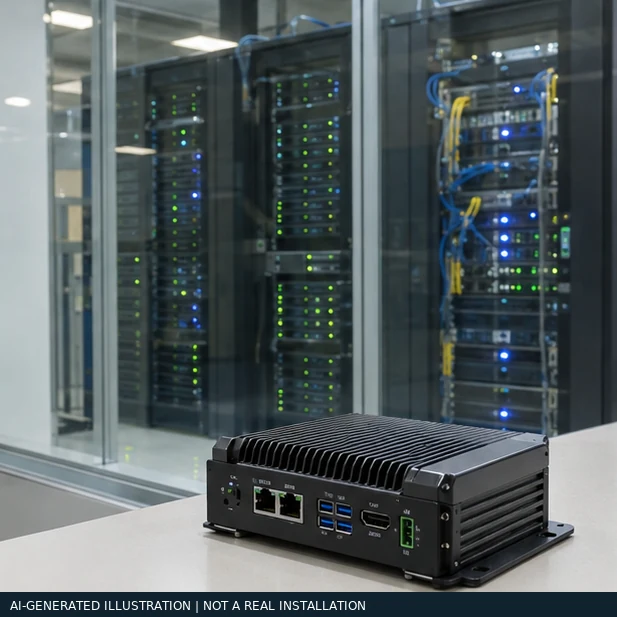
AI-generated illustrative scene, not an actual site, customer project, product interface or measured result. Equipment details and readings are illustrative only.
Start with constraints rather than an Edge or Cloud label
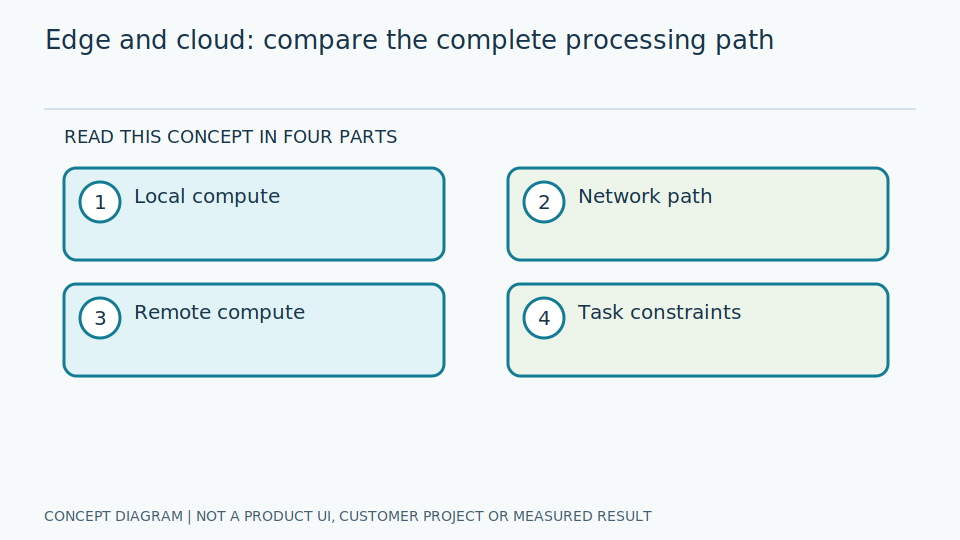
A gauge pipeline captures images, detects instruments, converts geometry into values and units, validates quality and delivers results. These stages can run in different places. Edge processing is near the image source; cloud processing uses centralized resources. Suitability depends on networking, image volume, data policies and acceptable response time. Neither location is inherently more accurate in every situation.
Compare using the same measurements
- Latency: measure capture-to-receiver time, separating queues, processing and transport. Report distributions such as p95/p99, not inference alone.
- Networking: cloud processing may require substantial image uploads; edge can send values and selected evidence, but still needs outage and retry design.
- Maintenance: edge devices need temperature, storage and version management. Centralized services simplify some tasks but add transport costs and access requirements.
- Data: establish whether images may leave the site, retention, permissions and deletion. Local deployment does not automatically establish security.
A verifiable hybrid example
An illustrative architecture processes and validates at the edge, buffers during outages, then sends values with timestamps, quality, model version and event identity. Review images follow a separate policy. Repeated delivery must not create duplicate records, and successful upload time must not replace capture time.
Do not hide unreadable observations
Reflections, hidden needles or thermal slowdown require appropriate invalid or stale states rather than invented numerical values. Dashboards must distinguish the last successful observation from newly received data. Ordinary image monitoring is not a substitute for protective circuits or emergency shutdown.
Before selecting an architecture
- Collect images across shifts and measure actual bandwidth, rates and point counts.
- Run the same evaluation on target hardware, measuring error, latency, memory and power.
- Simulate lost connectivity, full storage and restart; verify buffer and ordering recovery.
- Include devices, licenses, networking, maintenance and upgrades in lifecycle costs.
- Assign update, revalidation and recovery ownership before a pilot.
Identify which stages must be online
Separate capture, processing, quality checks, delivery and human review. Some work can accept later historical recovery; other work needs a new value before a deadline. Defining these requirements first prevents architecture labels from concealing the actual decision constraints.
If only numerical results leave the site, decide how errors can be investigated. Selected images may support review but need selection rules, permissions and storage limits. Sending every frame or retaining evidence without bounds is unnecessary. Evidence management belongs in the architecture rather than being added after installation.
Observe bottlenecks and temperature during actual workloads
Inference time for one image is not the time users receive results. When capture outpaces processing, queues grow and accurate answers become stale. Measure arrival rate, processing throughput and observation age together, including simultaneous cameras, rather than benchmarking only isolated images on a development machine.
Field devices can slow under heat or resource pressure; central services can wait on transport and scheduling. Run long enough to observe sustained behavior and resource use. Short tests on a cool, lightly loaded machine cannot establish performance throughout a production cycle.
Choose from evidence and maintainability
Compare alternatives using identical images with fixed models and preprocessing. Revalidate reading quality after runtime or resolution changes. Faster execution is not a useful improvement if relevant details disappear or rejection rates prevent the required operational coverage.
Identify device, update, backup and recovery owners and user fallback when the new system is unavailable. The appropriate architecture satisfies actual requirements and can be maintained, rather than simply using the newest components. These examples are design guidance, not confirmation of hardware or services already delivered by GaugeSnap.
Further reading
Edge AI principles · Edge Gateway · NIST: Fog Computing Conceptual Model
Scroll the diagram horizontally to inspect all details.