
Principles, Scenarios and Suitability
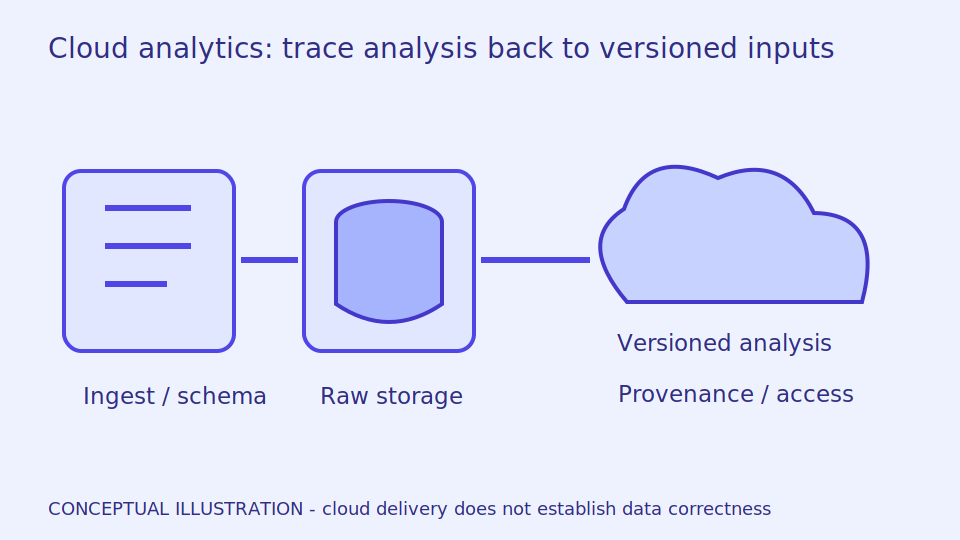
Cloud analytics combines and processes multiple sources while separating ingestion, storage and analysis for traceability. Design schemas, time handling and permissions from the start. Uploading data does not automatically produce correct insights or make unlike operating contexts comparable.
Cloud computing provides resources accessed over a network. Ingestion receives data, storage keeps it and analysis transforms it into answers. Like a library, information needs organisation before useful searching. Different units or product names across plants remain different after upload. Agree their meanings before presenting comparisons as fair.
A schema defines fields and types; a data contract adds meaning and quality expectations. Detailed retention supports investigation but increases cost and personal-data risk. Choose detail for the question and assign data owners. Cross-plant analysis must preserve load context and missing periods, not replace production and engineering review with a summary tool.
Scroll the diagram horizontally to inspect all details.
Illustrative Design Scenario
Illustrative design scenario: compare energy per production unit across plants while preserving product type and operating-period context. The dashboard identifies gaps instead of ranking plants by raw totals that are not directly comparable.
Suppose one plant streams readings while another uploads after each shift. Mid-shift totals are not yet comparable. Mark the second plant incomplete and defer conclusions rather than filling absent readings with zero. Apply late records to their source intervals and record why a revised report differs from its previous version.
Daily summaries reduce transfer effort; frequent trends can reveal short events but require better timestamp quality. Choose based on the actual decision, then test duplicates and failed jobs with test data. Before proposing image upload, assess personal information and the alternative of sending only derived results.
Inputs and Prerequisites
Use source-specific data contracts, retention policies, storage regions, permissions and transfer costs. Define event time, ingestion time and handling for delayed or duplicate records.
Event time comes from the source; ingestion time records system receipt. Keep both with a permanent event identifier. Retention means storage lifetime and should follow the purpose, not an assumption that every image must be kept indefinitely simply because storage is available.
Output should identify interval, source boundary, units, transformation version and completeness. Authorised reviewers must be able to trace totals to raw records. Avoid exposing another source through excessively detailed aggregates, even if direct access to its underlying records has been restricted.
Trial and Integration Workflow
- 1Validate schemas and retain versioned raw records before transformation.
- 2Build pipelines that can rerun without adding totals twice.
- 3Separate development and production, monitoring freshness, completeness and cost.
Evaluation and Acceptance Criteria
Reconcile totals from source to report and test reruns after failed jobs. Measure time to usable data, including queues and batches, together with missing volume. Acceptance should include recovery and cross-department permissions rather than query speed alone.
A pipeline is a sequence of transformations. Running the same input again must produce the same totals, including after partial failure. Fast queries alone may conceal duplicated records or a unit conversion that systematically corrupts the whole dataset.
Data owners should check sample reports and retrospective corrections. Test accounts that must not see another plant. Assess costs against the tested volume and retention policy, without presenting experimental figures as a commercial quotation or guaranteed service price.
Scroll the diagram horizontally to inspect all details.
Failure Cases and Limitations
Network needs and costs grow with volume. Images containing people may be unsuitable for cloud transfer without assessing purpose and access rights. Central analytics should not be the sole dependency for local process control.
Having a copy does not prove recoverability. Test reading the copy and rebuilding reports within authorised boundaries, including required configuration and transformation versions. Successful file storage alone does not establish that the complete analytical workflow can be recovered.
An insight is an observation requiring investigation, not independent proof of cause. Expanded analysis or storage in a particular region requires actual assessment. These are design questions, not claims about current capabilities or assurances of legal compliance.
Practical Checklist
- Can pipelines rerun without duplicating results?
- Can users access only authorised sources?
- Have recovery and cost assumptions been tested?