
Principles, Scenarios and Suitability
Traceability links material, batch and item events through processing. Codes alone are insufficient: establish what happened, where, when and who or which system recorded it. A traceable record does not automatically mean an audit has been passed.
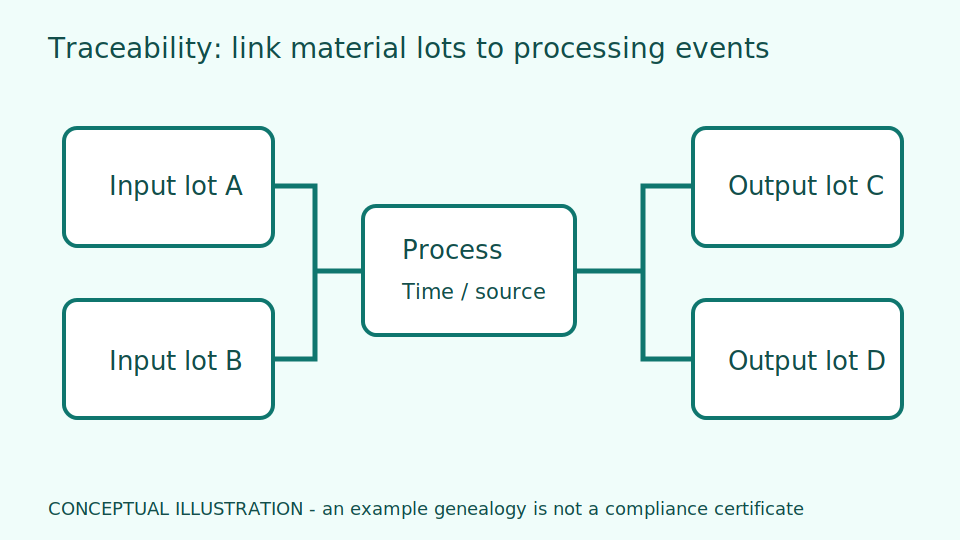
Traceability follows relationships between materials and products. A serial identifies one item; a lot identifies a group. Think of an ingredient map showing where a set originated and where it went. Splitting divides a set; merging combines sets. Scanning records one event but must still link quantity and condition changes. Readable codes do not automatically create complete paths.
An event model agrees shared record names and meanings. Detailed records aid tracing but increase recording workload and data-access requirements. Identifiers must not collide across factories; keep source times separate from receipt times. An audit trail tracks changes but cannot prove self-entered information true. Process owners must reconcile and review conflicts, not use automatic reports to declare an audit passed.
Scroll the diagram horizontally to inspect all details.
Illustrative Design Scenario
Illustrative design scenario: a raw-material batch splits across production orders and merges into finished batches. Backward searches must return every path, quantity and exception rather than selecting one tidy path for a report.
Hypothetically, 100 kilograms splits into 40 for the first job, 50 for the second and 10 remaining. Track all three. If job two merges with another lot, its finished-product path must link both sources. The 90 kilograms entering production does not establish that the remaining portion vanished without checking inventory records.
Options include recording immediately at workstations or consolidating after a shift. Immediate records are fresher but add devices and workload; consolidation risks memory errors and delay. Choose for the actual need, with conflict-correction queues. Rehearse simulated recalls to find affected groups, not actual recalls or worker accusations from incomplete paths. Responsible personnel must review before real action.
Inputs and Prerequisites
Use material, batch and serial identifiers, locations, times, split/merge events and quantities. Define correction and retention policies that correspond to the actual process.
Keep units and approved packaging conversion factors, persistent event IDs and source owners. Record waste, rework and remaining inventory separately. Do not force output to equal input by deleting real exceptions.
Return source and destination paths, quantities and evidence gaps, with correction histories. Limit recorder information to inspection responsibilities, not unnecessary personal disclosure merely to make reports more detailed.
Trial and Integration Workflow
- 1Define an event model and identifiers that do not collide across systems.
- 2Record splits and merges with quantities and source-evidence links.
- 3Rehearse batch tracing and make corrections while retaining the original history.
Evaluation and Acceptance Criteria
Check upstream and downstream path completeness and reconcile quantities. Rehearse a simulated recall and count missing or wrongly linked records. Include late events and historical corrections rather than merely confirming that codes scan successfully.
Upstream traces origins; downstream traces destinations. Rehearse both through several split and merge layers. Late events arrive later despite occurring earlier, requiring path updates without duplicating quantities.
Responsible personnel should compare sample paths against job orders and inventory, including unfound items. Retrospective corrections must retain original events and editors. Finding one code in a database is insufficient for acceptance.
Scroll the diagram horizontally to inspect all details.
Failure Cases and Limitations
Incorrect source records remain incorrect even in a hard-to-alter ledger. An audit trail does not establish the truth of its contents or replace reviewers. Actual recalls require responsible personnel to review consequences and applicable requirements.
A ledger still depends on source-data quality. Difficulty changing it does not turn wrong data correct. Use traceable compensating or correction entries under the process, not conceal ambiguous paths to make reports complete.
Traceability standards guide design, not certify factories or audit results. Future multi-system integration needs actual code, unit and permission checks, not claims of complete tracing across every process or guaranteed recalls.
Practical Checklist
- Are quantities fully tracked across both splits and merges?
- Do corrections leave the original events visible?
- Have searches from finished products to raw materials and back been rehearsed?