
Content Level: Overview / Implementation considerations
Principles and Suitability
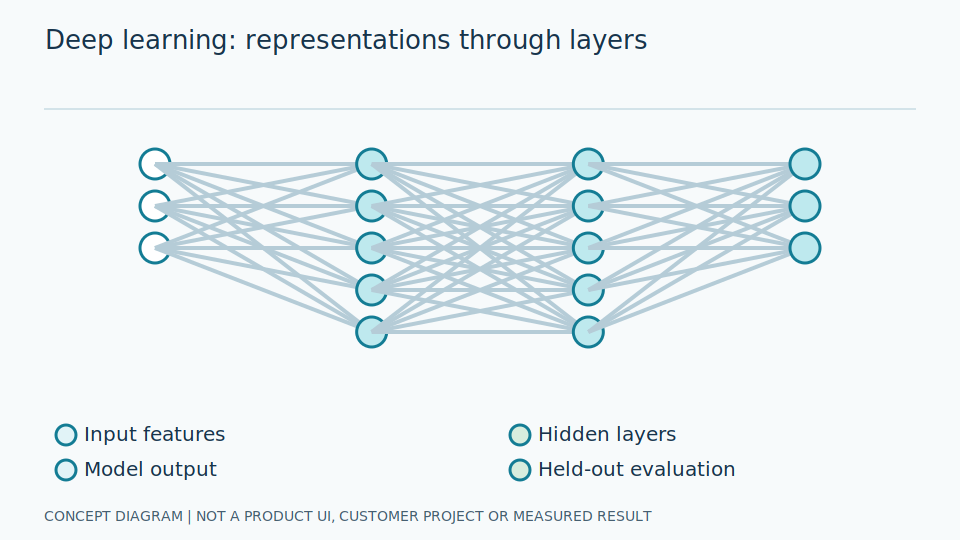
Deep Learning uses multiple computational layers to learn representations together with the final task, updating weights through backpropagation. Pretrained models provide a starting point, but features learned from their source data may not suit industrial dials.
The system learns how to summarise images instead of requiring every edge to be specified by hand. Early layers may respond to lines and colours; later layers combine information for a task. Complexity does not automatically provide understanding of units or permitted conditions. Learning still depends on selected images and answers, including their gaps and misleading patterns.
Backpropagation sends error information backwards through layers to update weights. A backbone extracts representations for a prediction head. Freezing weights reduces the parts needing adjustment; fine-tuning adapts them to a new task. Choose according to available data and the risk of losing previously learned features, rather than assuming that updating every layer is better. Either choice needs independent evaluation.
Scroll the diagram horizontally to inspect all details.
Illustrative Industrial Example
Illustrative design scenario: fine-tune an image model to locate pointers on different gauge designs. Keep scale interpretation as a separate geometric step so that the origin of the resulting numeric reading can be inspected.
Suppose some gauges have dark pointers on pale faces and others the reverse. Include both appearances rather than putting one only in training. Transformations must retain the tip: shrinking until it disappears leaves a label without corresponding evidence. Good training results might then reflect memorised dial appearance rather than pointer identification.
Inspect inputs after resizing and colour conversion, and overlay the prediction head's coordinates on originals. If output changes from a point to a line, recheck its angle-conversion connection. Compare frozen and fine-tuned backbones on the same validation set. Retain results from each training stage to distinguish learning detail from memorising images or backgrounds.
Study and Trial Workflow
- 1 Choose the backbone and image size according to the pointer details that must remain visible.
- 2 Compare a frozen backbone and fine-tuning using the same validation dataset.
- 3 Test the exported model on the target hardware with a held-out dataset.
Evaluation and Metric Definitions
Report learning curves, results across different gauge units and final reading error alongside memory consumption and latency. Selecting the model with the lowest loss alone does not establish that the complete reading pipeline is suitable.
Learning curves show training progress. Falling training error alongside rising validation error can indicate memorisation rather than generalisation. Compare these with actual reading error. Slightly better pointer detection may be useless if unit interpretation remains wrong, or may matter greatly near the scale ends. Evaluate the result users need, not only the intermediate optimisation target.
Test exported and training implementations on identical images. Check colour-channel order, pixel scaling, input shape and coordinates. Measure from image receipt to a result with supporting information, rather than only computation on convenient hardware. If memory is insufficient or export changes predictions, inspect the real execution path before deciding that the version is ready for trial.
Limitations and Failure Cases
Overfitting and domain shift remain possible even with substantial training data. Misleading image patterns or an obscured pointer can produce confident errors rather than a reliable indication that the scene is unreadable.
Domain shift means changed data conditions since training, such as a new lens, dial colour or compression method. High scores on unsuitable images reflect model responses, not confirmation that conditions were validated. Assess quality and out-of-scope examples separately from the main predictor. Confidence cannot replace missing evidence or evaluation of unfamiliar operating conditions.
More resolution or layers may preserve detail but increase memory and time requirements, and cannot repair incorrect answers. Reduction for small devices may affect thin pointers more than large objects. Define no-read cases and retain review evidence. Deep learning is no justification for bypassing scale, unit or downstream safety checks; complexity does not remove those responsibilities.
Practical Checklist
- Are pretrained weights and their usage rights recorded?
- Are random seeds and dataset versions controlled?
- Have out-of-distribution images been included in testing?