
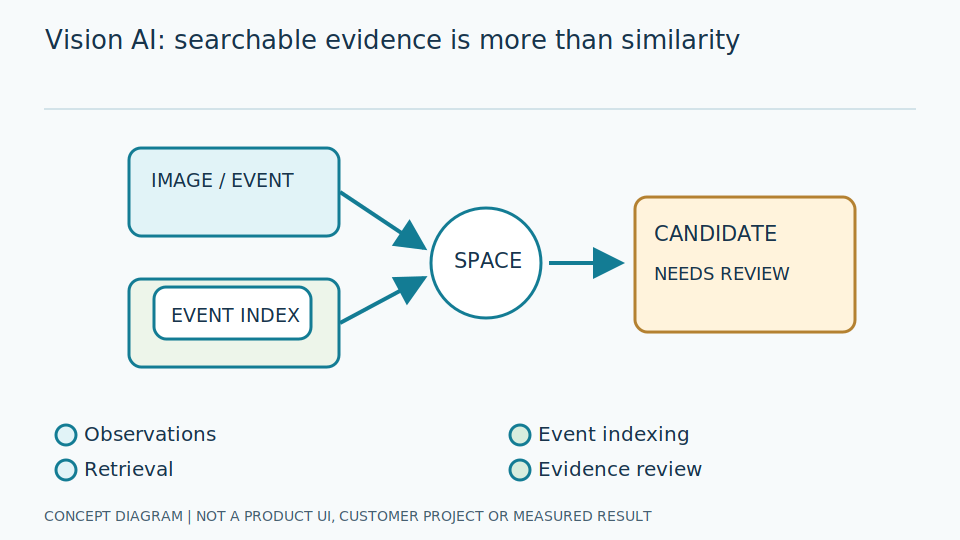
A search result is a claim that needs evidence
Vision AI connects image interpretation with information retrieval. Detection proposes objects in frames, tracking associates observations over a limited sequence, and language can help describe what a user wants to find. None of these steps alone establishes that a particular event happened as described.
Begin with an observable question rather than a model name. Finding a person carrying a box requires evidence about the person, the box and their relationship at compatible times. A frame containing both objects is not enough. A useful result should explain which conditions are supported, contradicted or still unknown.
Read the four articles in pipeline order
Detection event indexing explains how observations acquire event identifiers, source times, bounded track identifiers and explicit missing-value states. Natural-language search then separates user intent into confirmed time and camera constraints, observable descriptions and relationships. Read these first when the central problem is what the stored data actually means.
Multimodal hybrid retrieval combines structured filtering, image and text vectors, evidence reranking and temporal aggregation. Visual search evaluation tests whether the resulting events answer the question, rather than merely looking similar. Read these next to understand candidate loss, misleading scores, privacy boundaries and the difference between no match and an incomplete search.
- Step 1: Detection event indexing — establish a traceable record and its lifecycle.
- Step 2: Natural-language search — interpret composition without silently resolving ambiguity.
- Step 3: Multimodal hybrid retrieval — rank evidence inside mandatory constraints.
- Step 4: Visual search evaluation — measure event relevance, coverage and operational limits.
Scroll the diagram horizontally to inspect all details.
A vocabulary and three deeper studies
Classification assigns a category; detection adds a location; segmentation assigns pixels; tracking associates observations across frames. An event adds application-defined temporal boundaries and relationships. Retrieval selects existing candidates, while generation writes an answer. A fluent generated sentence is not another observation and cannot repair absent evidence.
An embedding is a numerical representation, not a record of every visible fact. Read Embeddings and Vector Search for cosine similarity, normalization and the difference between approximate neighbor recall and relevant-event recall. Similar vectors can still disagree about the person holding an object, and different model versions need compatible representations before their distances mean anything.
Temporal Grounding explains when evidence supports an action and how sampling or mismatched intervals lose it. Evidence-grounded RAG explains how retrieved records can support a cited answer, when citations are insufficient, and when to abstain. These three studies extend the four core articles rather than replace their indexing, query-validation and evaluation requirements.
- Observation: what a source frame or interval supports, with its provenance and uncertainty.
- Grounding: linking a condition or answer to the correct region, subject and time.
- Coverage: the portion of eligible data that was available and searched, not a confidence score.
- Abstention: explicitly declining an unsupported answer, not replacing it with a plausible default.
One question, several distinct conditions
Consider the translated query “Find a woman in a red shirt holding a box around 13:00”. Treat the person category as the user’s description of apparent presentation, not proof of gender identity or sex. Do not infer protected traits or identity. Uncertain visual interpretation requires review, not punitive automation.
The date, timezone and meaning of “around” still need user confirmation. The red shirt must belong to the described person, and that person must be holding the same box in the evidence. Time, camera and numerical-value filters are hard constraints; semantic similarity cannot guarantee logical AND or relationship correctness. Missing observations are not negative evidence, and an invalid reading is not zero.
Scroll the diagram horizontally to inspect all details.
Connect foundations to a planned application
The technology articles linked below introduce Computer Vision, Object Detection, tracking and re-identification, and vision-language models. Use them to understand model families before interpreting retrieval behavior. A detector such as DETR addresses object localization; CLIP-style representations address image-text similarity. Neither paper establishes the accuracy of a complete event-search application.
AIFacon Detection is a planned product direction involving object detection, event indexes and NLP search over stored fields together with image or video meaning. This library explains principles relevant to that direction, not available features, certified results or a working search demonstration. Deployment choices, access rules and validation remain separate decisions.
Ask what the search can and cannot support
Check permission before retrieval and candidate ranking, and check it again before playback. Ask whether delayed footage has arrived, whether indexes are complete, and whether expired or deleted sources have corresponding index, embedding and cache removals. An empty page alone cannot distinguish an absent event from missing rights or missing data.
Evaluate at event level with documented relevance labels, Recall@K, Precision@K and end-to-end latency. Separate development and test by camera and day to limit similar-frame leakage. NIST AI RMF provides a risk-management vocabulary, not certification of these pages or a promise that any planned system meets a particular standard.
References and further reading
- 1. Detection event indexing
- 2. Natural-language search
- 3. Multimodal hybrid retrieval
- 4. Visual search evaluation
- Deeper study: Embeddings and vector search
- Deeper study: Temporal grounding
- Deeper study: Evidence-grounded RAG
- Computer Vision foundations
- Object Detection foundations
- Tracking and re-identification foundations
- Vision-language foundations
- AIFacon Detection: planned product context
- DETR: End-to-End Object Detection with Transformers
- CLIP: Learning Transferable Visual Models From Natural Language Supervision
- NIST AI Risk Management Framework