
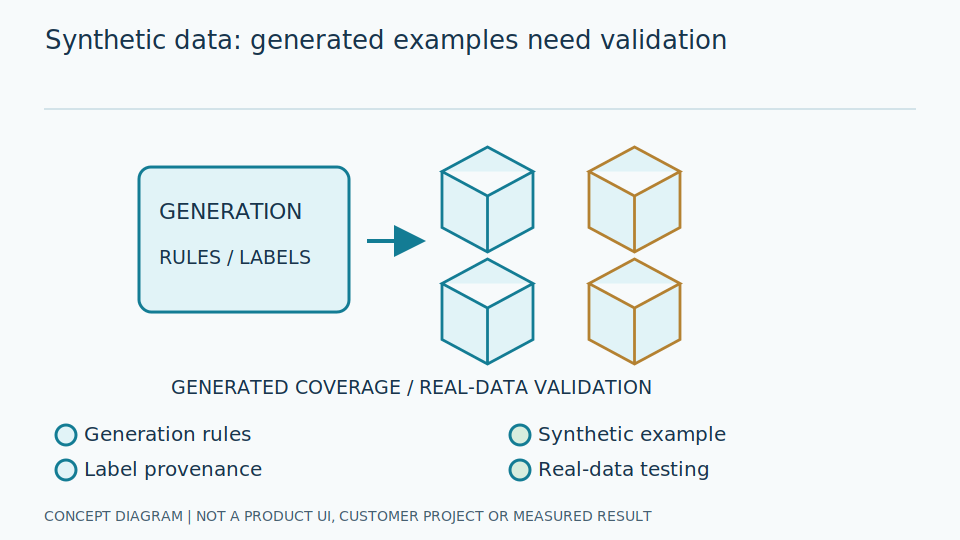
Content Level: Overview / Implementation considerations
Principles and Suitability
Synthetic data can come from geometric rendering or generative models. Rendering can control known values and positions, whereas a generative model may produce realistic-looking images without preserving numbers or scale marks. Separate the origin of an image from the origin of its label: visual plausibility does not establish that the recorded answer matches the picture.
Synthetic data is created rather than captured from a real event. A renderer draws images from a design and parameters, such as dial geometry and needle angle. Knowing the supplied angle provides an initial answer, but simulated lenses or occlusion require checking whether that answer remains visible. Visual realism and correctness against the design are different requirements, and both must be examined.
Engineers define verifiable equations from values to angles and from design coordinates to image coordinates. If a generative model alters an image, inspect the features on which its answer depends. Provenance records origins and creation steps alongside parameters and component usage rights. A simulator's known value does not guarantee representation of errors in real equipment when those effects were omitted from the model.
Scroll the diagram horizontally to inspect all details.
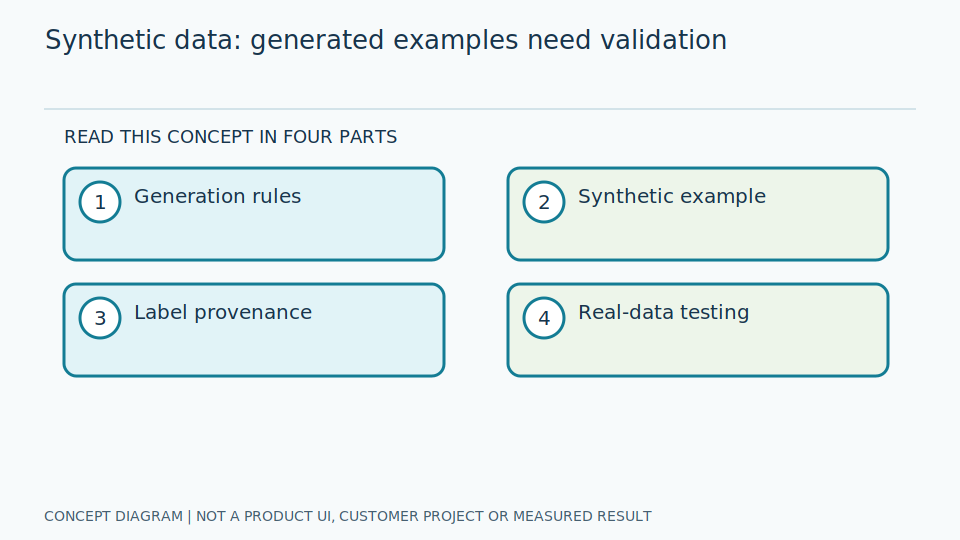
Illustrative Industrial Example
Design example: construct a dial from a defined scale and rotate its needle to a known value, then simulate lenses and lighting. This does not imply coverage of every reflection or damaged condition found in real equipment. The generated image remains an example from a particular model with explicit assumptions, not a record of field operation.
Suppose a simulated dial has a linear scale, a defined unit, and a clear increasing direction. Marks and numbers must correspond to the needle angle, rather than drawing a dial-like picture and assigning random values. If reflections conceal the tip, the image may help train rejection but should not retain an unqualified readable label. Distinguish images supporting gauge detection from those supporting clear value reading.
Engineers check generated views against calculated coordinates and values using simple verification tools or manual review. Compare real-only training with mixed training on the same independent real test set. Record missing material-specific effects instead of claiming that numerous lighting patterns ensure complete operational coverage. Images originating in the test set must not become raw material for creating training images.
Study and Trial Workflow
- 1 Define image parameters and verifiable label equations.
- 2 Record provenance and inspect usage rights for assets used in generation.
- 3 Mix synthetic data into training only, retaining a holdout exclusively from independent real images.
Evaluation and Metric Definitions
Compare real-only and mixed training on real images grouped by condition. Inspect the domain gap and label discrepancies after rendering, rather than judging solely by visual realism. The comparison concerns the downstream task on independent observations, so an attractive generated collection or strong results on its own images cannot establish operational usefulness.
The domain gap is the difference between created and real data, such as glass surfaces or compression effects that the simulation does not reproduce. Examine whether mixing helps targeted groups or harms others, and report real-image counts. Separate generation-label errors from model errors: mismatched pictures and values complicate interpretation even when the creation software runs without a programming fault.
Engineers verify reproduction from parameters and generator versions, including source images and usage rights, then measure downstream performance on real images unrelated to development. Evaluate separate generated collections independently to identify their contributions. Do not present synthetic-image scores as field results. Report unreadable cases too, so unrealistically perfect simulated images do not conceal the difficulties of receiving pictures from real cameras.
Limitations and Failure Cases
Generators can produce incorrect scale marks, implausible defects, or copies of source material. Synthetic data is not field-test evidence. Its labels and appearance need review, and its provenance must remain clear so readers do not mistake a created image for a captured event or treat a simulation result as verified operational performance.
A simulator includes selected factors and inevitably leaves others out, such as material aging or multilayer reflections. Broad parameter randomization supports exploration but does not prove coverage of every real influence. List assumptions and validate with real data. Do not portray simulated images as events that actually occurred or use them to substantiate capabilities that remain unevaluated in the relevant scope.
Generation can reduce some collection constraints but adds verification costs and model maintenance. Incorrect readable details may teach generator artifacts instead of real patterns, requiring documented filtering and corrections. External components still carry usage conditions. This is a design and research option, not a statement that a product includes a simulator or has already improved reading performance by any particular proportion.
Practical Checklist
- Can labels be independently checked by calculation?
- Is generated data kept out of the test set?
- Is a list of the simulator limitations documented?