
Content Level: Overview / Implementation considerations
Principles and Suitability
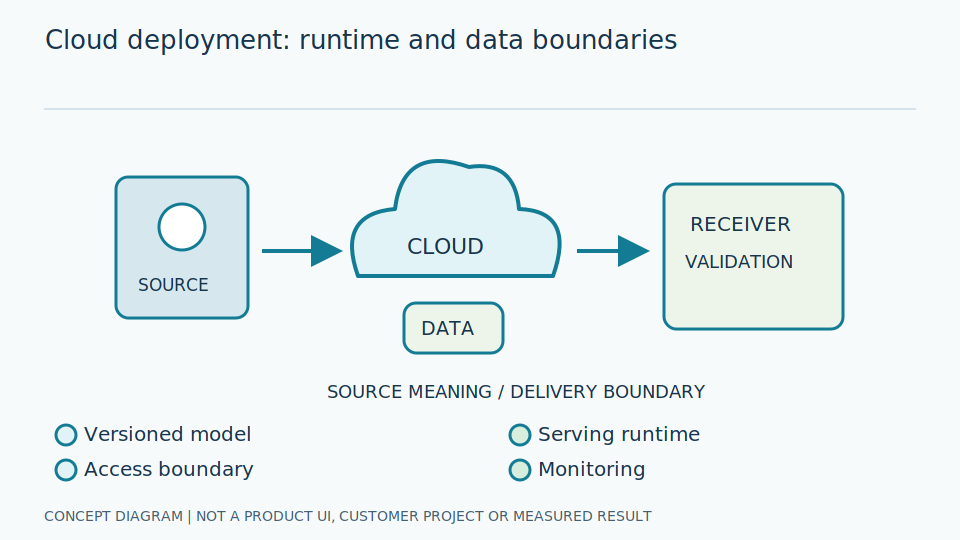
Cloud services consolidate compute and management but add network dependence, image-transfer requirements, and data boundaries. Deadline-sensitive or high-risk tasks should consider processing near the site rather than assuming cloud placement suits every component. Architectural choices must reflect the task's timing and failure consequences, not simply the availability of a powerful remote processor.
Cloud resources provide processing and storage through network services, supporting work from multiple sources but adding transfer time and resources. A region is a service location; retention is the storage duration. Selection requires more than renting a fast machine: identify permitted data, authorized access, and outage behavior before assigning system roles. These decisions govern what can be sent and what users see when delivery fails.
Engineers separate image reception, reading, storage, and review, documenting where each belongs in a data-flow plan. Egress is data leaving a service and may add costs alongside compute, storage, and retries under assumed or measured workloads. Duplicate-safe reception needs identifiers and destination rules, not an expectation that every network transfer succeeds exactly once without interruptions or repeated delivery.
Scroll the diagram horizontally to inspect all details.
Illustrative Industrial Example
Design example: read gauges at the edge and send values with event-specific images to cloud review, separating historical display from machinery control. This allocates different roles to local reading and central review rather than assuming that a remote service remains available for every time-sensitive decision or that delayed observations describe the current process.
Suppose local reading continues but the central service is unavailable. The review page may lack new information and must show the latest observation time and incomplete status, not an old value as current. Event-only image upload limits data but needs explicit event-selection rules and consideration of normal samples for quality checks. Otherwise review data is biased by the model's own alerts from the outset.
Engineers test retries and offline queues with simulated data without affecting real work. Check image and event identifiers, units, versions, and capture times. On reconnection, distinguish backfilled records from fresh ones and verify completeness after repeated transfers. Define processor permissions and retention before uploading images, not after storing them and discovering confidential or personal information that should have been considered earlier.
Study and Trial Workflow
- 1 Define permitted data, region, retention, and authorized users.
- 2 Calculate bandwidth, compute, storage, and egress costs for the workload.
- 3 Design duplicate-safe retries and offline behavior at the edge.
Evaluation and Metric Definitions
Test end-to-end latency under poor networking, cost per workload volume, and recovery. Audit access and completeness after retries. Measure the actual user-facing data path rather than isolated service computation, and ensure repeated transmission does not silently create extra records or conceal losses behind a successful connection indicator.
Measure from the observation until data reaches the recipient according to task meaning, not just service computation time. Costs need declared boundaries and image volumes, including storage, egress, and retries, with a baseline before claiming savings. An audit examines access and change history, assigned to responsible personnel and checked for enough completeness to diagnose the relevant incidents rather than simply confirming that logs exist.
Engineers simulate service unavailability, network loss, and full queues, checking that retries do not add incorrect records. Verify permissions needed by each stage and deletion under retention rules. If resources scale automatically, examine queues and startup behavior too: machine counts alone do not establish timely delivery. SRE and OT guidance supports operational design, not certification of service availability.
Limitations and Failure Cases
Autoscaling does not restore a disconnected camera's network, and cold starts can increase tail latency. Selecting a region alone does not establish legal data compliance. Cloud architecture needs explicit operational and data-governance boundaries, rather than relying on service location or resource elasticity as a blanket assurance of availability, privacy, or suitability for the intended task.
Autoscaling increases or decreases resources under defined rules; cold start is the readiness period that may involve loading models and data. Added machines still cannot receive images across a broken camera connection, so specify offline behavior. Storage location alone does not address every legal requirement. Consider purpose, rights, processors, and access within context rather than assuming regional placement resolves all data obligations.
Centralization simplifies some administration but increases impact from central failure; distribution can help while adding version and data coordination work. Choose according to requirements, not cloud terminology as an assurance of security or scalability. This architecture option does not confirm current product support for particular services, regions, or autoscaling mechanisms. Safety circuits must not rely on an assumption of permanently available networking.
Practical Checklist
- Are data flow and processor boundaries documented?
- Are resource quotas and service-cost alerts defined?
- Can cloud failure occur without issuing incorrect control actions?