
Principles and Suitable Contexts
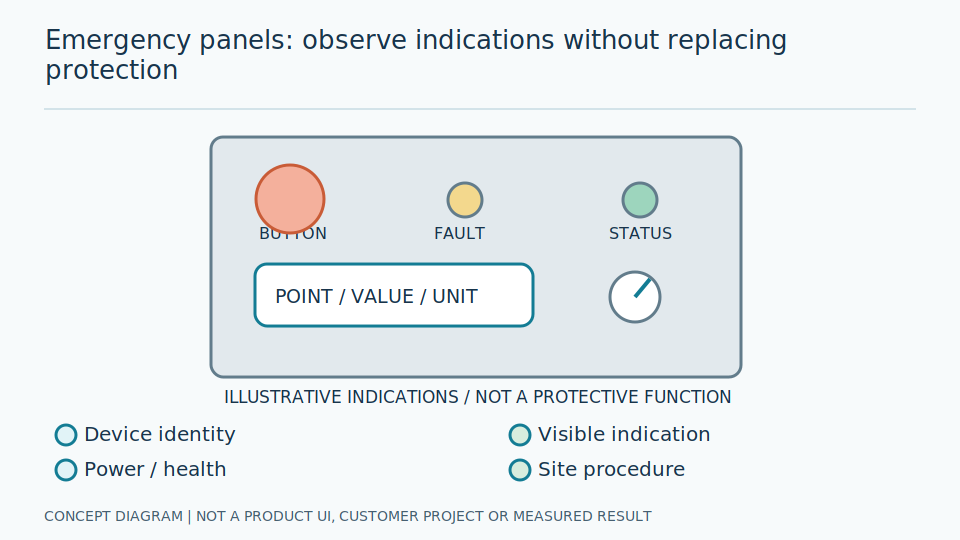
Seeing an emergency button or indicator establishes only its external appearance. It does not verify contacts, wiring or removal of hazardous energy. Image reading can provide supplementary records and help identify discrepancies; it is not a replacement for SIS, emergency stop circuits or interlocks.
A safety instrumented system, or SIS, uses designed sensing and other components to bring a process to a specified state. Emergency shutdown, or ESD, has its own defined system scope. A pressed-button image shows appearance at capture time, not verified energy isolation or absence of hazards. Avoid language that calls this visual state a safe stop, since that claim needs different evidence.
Images may help reconstruct what a panel displayed during an event, but are not a protective layer waiting for recognition or network delivery. Separate observations from circuit-test results and restart authorisation. Safety references help define responsibilities and boundaries; citing them does not assign reliability levels or approval to camera software. The emergency function must remain independent of whether supplementary images are available or readable.
Scroll the diagram horizontally to inspect all details.
Data and Preparation
Start with circuit diagrams and state definitions approved by the responsible safety personnel. Collect images during existing authorised tests, rather than pressing buttons merely to generate data. Record capture times and the independent means used to confirm that the machine stopped, keeping that evidence separate from image labels.
List only visible elements, such as button-head position, lamps and panel text, with reporting terms that avoid conclusions about internal circuits. Camera installation must not block button access, labels or operator sightlines. Confirm this with responsible personnel before use, and keep image configuration entirely separate from safety-circuit modification. The desire for a better dataset is never a reason to alter a protective circuit.
Define stale-image presentation and reference times, including evidence-viewing permissions after events. Never require a camera response before the existing emergency channel operates. Obtain rare states from authorised inspection records; if examples are absent, document the test gap. Do not stimulate the circuit to fill it, or claim panel readiness merely because the camera successfully recognises the normal external appearance.
Failure Cases and Limitations
A stuck button or failed lamp can leave an apparently normal image despite a circuit problem. Camera or network loss must not impair emergency stopping. Never wait for image confirmation before following emergency procedures, and do not use a panel image to authorise resetting or restarting the machine.
A sharp old frame may inspire more confidence than a current obstructed one. Show capture time and missing-data status explicitly; image loss must not become ready. Reflections and hidden labels should be reported as observation limitations, not emergency-system test results. Operators still act on primary signals and procedures without waiting for supplementary image processing, regardless of how confidently a previous frame was classified.
A returned button does not mean the event is cleared or restart is authorised. Acknowledgement, reset and restart have distinct conditions defined by the system. Summarising all of them as normal can skip essential procedures. Preserve the observed state and limitations. Never generate training examples by pressing buttons, bypassing circuits or testing energy removal outside procedures approved by the responsible qualified personnel.
Evaluation Methods
Assess image classification separately from safety-function testing. Record missed states, stale images and delay. Image-reading results do not establish a safety integrity level (SIL) or certify compliance with a standard. Functional circuit verification remains the responsibility of appropriately qualified personnel under the applicable procedures.
SIL concerns requirements for the integrity of a safety function, not an image-accuracy score. Independent reviewers should label only visible buttons, lamps and text before comparing output. Include absent, repeated and ambiguous frames using recorded material or clearly labelled simulated imagery. Do not create a real emergency to build a test set; testing the observer must not interfere with the protected process.
Acceptance should establish whether users can distinguish observation from circuit verification. Check that screen wording and colours do not imply safety when information is absent. Evidence should identify image time and reference-answer provenance in every case. Report important errors separately instead of averaging them away, and preserve an explicit handover restriction: image results cannot serve as conditions authorising reset or machine restart.
Review Checklist
- Label this as a supplementary observation channel.
- Retain the independent emergency stop circuit.
- Show stale or missing images as unknown.
- Do not use image reading to approve reset or restart.
References and Further Reading
References explain principles, not product certification. Requirements from another jurisdiction do not automatically replace local requirements or the actual equipment manual.