
Content Level: Overview / Implementation considerations
Principles and Suitability
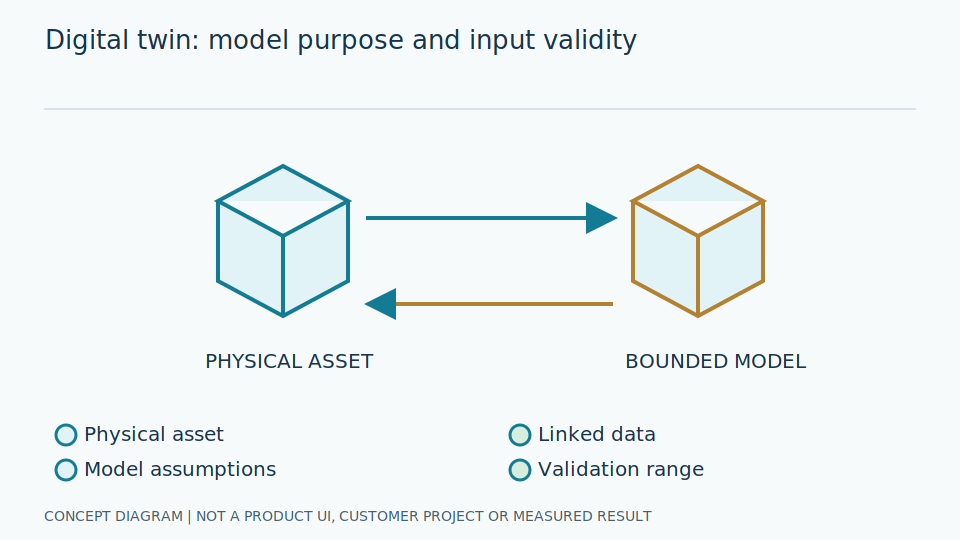
A digital twin needs an asset or process model with a defined purpose, detail level, and connection to its physical counterpart. A dashboard displaying current values alone does not establish simulation or predictive capabilities.
A twin is a representation designed for particular questions, not a complete copy of reality. Fidelity is the level of detail and closeness needed for those questions. A three-dimensional image can show locations but does not automatically supply equations or behavior. Separate visualization, modeling, and synchronization with physical states so users know which conclusions come from measurements and which depend on model assumptions.
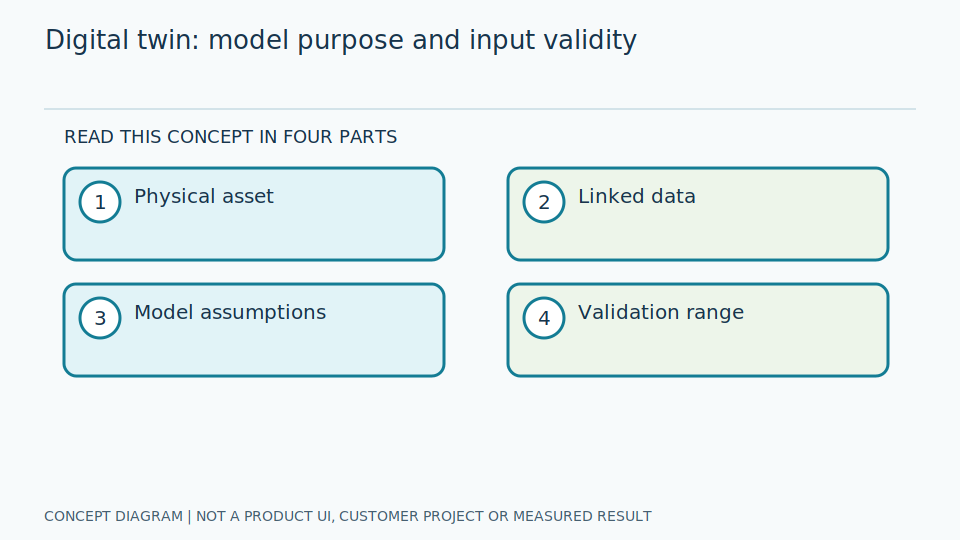
Engineers define parameters, equations, and an operating envelope, the supported conditions, with synchronization methods aligning data and model states in time. Check sensor or reader quality before integration; stale or unreadable values must not look current. Validation checks whether the model answers its scoped questions against independent data. Fitting parameters to one dataset and then showing agreement with that same dataset is not independent validation.
Scroll the diagram horizontally to inspect all details.
Illustrative Industrial Example
Conceptual example: a pressure-system model receives quality-checked instrument measurements to compare observed trends with modeled behavior. Displaying a three-dimensional view does not create a validated twin.
Suppose the model follows data during one period but diverges after operating conditions change. Users should see validated ranges and incomplete data. Divergence is not immediate proof of machinery failure: source measurements or parameters may no longer represent the new conditions. What-if analysis tests assumptions within a model. Display those assumptions rather than using simulations to recommend changes to actual operation without assessment by the responsible personnel.
Engineers separate parameter-fitting data from validation data and inspect measurement times against model states. Compare residuals across operating ranges and review changes to cameras or instruments. Test missing-data cases in the model or simulated inputs without commanding physical equipment. When source information is insufficient, report unknown status rather than filling in predictions and presenting them as a complete set of machinery measurements.
Study and Trial Workflow
- 1 Define the question, fidelity, and necessary physical parameters.
- 2 Specify synchronization and handling of missing or stale data.
- 3 Validate the model against experiments or independent data before using what-if analysis.
Evaluation and Metric Definitions
Measure residuals across operating ranges, state freshness, and uncertainty in simulation outputs. Separate sensor or reader error from equation error.
A residual is the difference between the model output and reference data, potentially including measurement error. Specify units and comparison times, together with parameter and source uncertainty. Agreement on one graph interval is not evidence for every condition. Evaluation must match the twin's question, such as trends over a defined period. Smooth visualization or attractive three-dimensional graphics is not a measure of behavioral simulation capability.
Engineers examine multiple approved ranges with independent data and incomplete cases. Check repeatability using the same model and parameter versions. Systematic errors across a range call for examining equations and timing, not blaming only the image reader. Uncertainty guidance helps organize evaluation components, while risk frameworks help plan result use. Neither certifies a twin nor establishes current product capabilities.
Limitations and Failure Cases
A model may be unreliable outside its operating envelope. Incomplete image data does not reveal every internal state of machinery.
Extrapolation outside validated ranges can produce numbers without evidence of reliability. Provide an out-of-scope state rather than displaying certainty equivalent to validated outputs. One dial shows only its displayed variable; it does not reveal every temperature, material property, or internal condition. Additional data may help particular questions, but a relevant model is still necessary. The name twin does not justify claiming knowledge of all asset states.
Detailed models increase construction and parameter-maintenance costs; simpler models may suffice for limited questions. Choose according to use and interpretation risk. Do not claim reduced costs or downtime without a real baseline. This example concerns model development, not current digital-twin services. What-if results are supporting information for consideration within approved boundaries, not control commands that bypass safety systems.
Practical Checklist
- Is the distinction between a model, dashboard, and twin clear?
- Is the validated operating scope defined?
- Do simulated results identify assumptions and the approving authority?