
Principles and Suitable Contexts
A gateway may translate protocols, validate schemas and buffer records before forwarding them. This is useful with varied legacy systems or intermittent internet access. Having an edge device does not guarantee timely responses, nor does it automatically make the system suitable for a safety circuit.
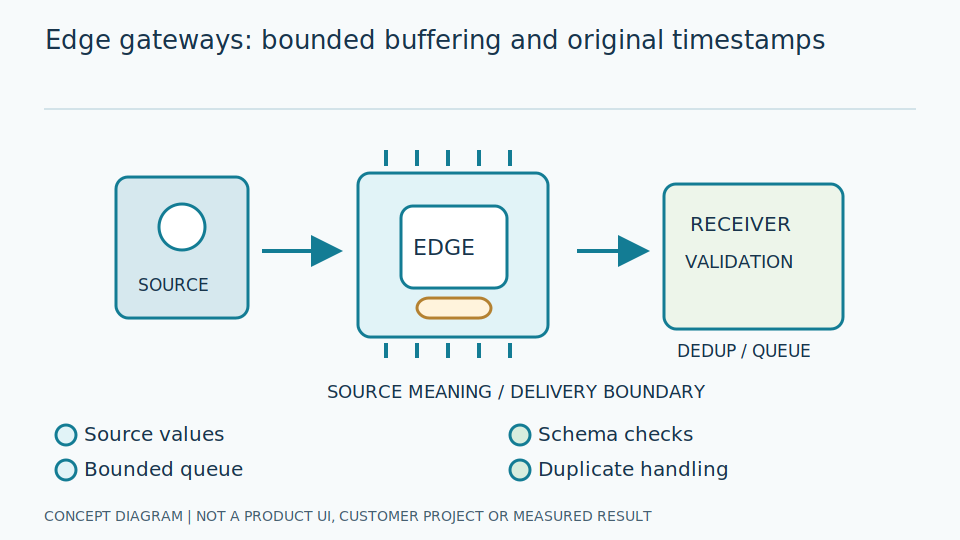
Edge means processing near the data source; gateway means a connection between systems whose rules may differ. Buffering prevents an internet interruption from immediately losing every record, but only within storage and queue policies. Separate measurement time from forwarding time: records arriving after reconnection may be valuable history rather than current equipment status. Their delayed arrival must not refresh the apparent measurement age.
A queue holds records waiting to be sent. Define whether destination acknowledgement means message receipt or durable storage. The point at which records are removed affects both loss and duplication risk. Preserve identifiers across retries and validate formats before queue admission. These are design concepts requiring proof on actual hardware, not claims that any named product already implements them.
Design and Data Preparation
Estimate data volume from record size, source count and reading frequency. Define the buffering duration, encryption and disk-full policy. Arrange a reference time source, certificate management and an update process that can be rolled back. Verify compatibility with the actual hardware separately rather than assuming it.
Include metadata and indexes in record-size estimates, not just measurement digits. Select an agreed overflow policy, such as rejecting new records or dropping records under a defined rule, and expose an observable overflow state. Larger queues buffer longer but need more drain time and maintenance. Capacity should match the question and importance of the data rather than being increased without considering recovery workload.
Map networks, identities and permitted paths, separating administration accounts from data-forwarding accounts. Record clock status when time synchronisation is unavailable. Updates need before-and-after versions and hardware-specific recovery methods. Use trial hardware or approved operating windows for failure checks; do not interrupt live process power to test gateway resilience. The test plan must preserve original plant functions independently of the monitoring equipment.
Scroll the diagram horizontally to inspect all details.
Failure Cases and Limitations
Full queues, power loss during writes and clock drift can lose or misorder records. Reconnection may flood the destination with old data. Rate-limit replay and retain original record identifiers so the destination can deduplicate records, instead of treating every retransmission as a new measurement.
A power interruption during writing can leave incomplete records. Check integrity before forwarding rather than filling missing fields with plausible defaults. If the destination receives a record but its acknowledgement is lost, retries should be expected. Creating a new identifier on each retry prevents deduplication and can incorrectly increase totals or event counts even though only one source measurement occurred.
Historical replay can compete with fresh data, so define observable priorities and rate limits. An empty queue does not prove complete delivery because records may have been discarded; retain discard counts and reasons. Keep this monitoring workflow separate from safety instrumented systems, interlocks and emergency-stop circuits, which must not wait on the gateway or an ordinary network to perform protective duties.
Scroll the diagram horizontally to inspect all details.
Trial and Evaluation Methods
Simulate network and power outages in a test environment. Compare record counts before and after recovery using source identifiers. Measure data age, queue backlog and drain time after reconnection. Check recovery from a full disk rather than reporting only latency while the system is idle.
Latency is delay between defined points; state whether timing begins at record receipt or actual measurement. Test known identifiers and order, asking an independent reviewer to account for received, queued and discarded records. Include destination receipt with missing acknowledgement to verify preserved retry identifiers and absence of duplicate side effects. Delivery counts alone cannot explain which source records were lost or repeated.
Acceptance should cover overflow policy, restart recovery and incorrect-time status at a documented workload. Report storage limits and actual gaps, not guaranteed response or availability under every circumstance. NIST and MQTT references help formulate identity and delivery questions; they do not approve gateways for safety functions or demonstrate compatibility with other hardware models. Limit conclusions to the configurations and failures actually exercised.
Review Checklist
- Define queue capacity and overflow handling.
- Test power loss and incorrect device time.
- Prevent duplicates after reconnection.
- Assign responsibility for updates and recovery.
References and Further Reading
References explain technology principles or requirements. They do not establish product certification or support for every requirement.