
Content Level: Overview / Implementation considerations
Principles and Suitability
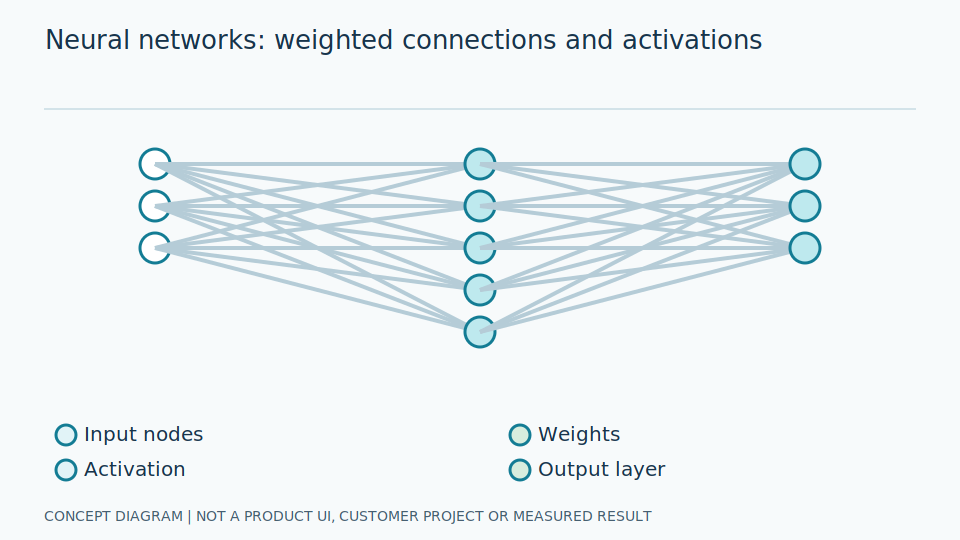
A neural network combines weights, biases and activation functions to represent nonlinear relationships. The loss defines what should be reduced, while the optimizer uses gradients to update weights. A network is not automatically a model of the brain or evidence of causal reasoning.
Each layer mixes and transforms information before passing it onwards. Weights determine each input's influence; a bias shifts the combined value. Despite the name neural network, this is computation using learned parameters. It does not understand the consequences of a wrong gauge reading as a human would. Mathematical operations and operational meaning remain separate questions.
Activation functions represent relationships beyond straight lines. Gradients indicate how to adjust weights to reduce loss locally. Define input shapes and output-head meanings, such as continuous values or class scores, with compatible scaling and constraints. Reusing an architecture does not make all units or tasks compatible: the input contract and objective must still match the intended output.
Scroll the diagram horizontally to inspect all details.
Illustrative Industrial Example
Illustrative design scenario: a multilayer perceptron (MLP) receives sharpness and brightness features to score image readability instead of consuming a whole image. This supports an experiment in which the input variables can be explained.
An MLP uses densely connected layers. A sharp image bright enough to hide the pointer should differ from one with the full pointer visible. Features describing glare or reading-region completeness may therefore be needed. Explain each variable's task relevance instead of adding every available measurement and expecting the network to establish meaning unaided.
Inspect individual inputs for correct sharpness, brightness and missing-value columns. Apply training-set scaling statistics without recalculating them for each new input, then examine scores before and after thresholding. Reordered features can produce normal-looking but meaningless numbers. Reference examples should test stage connections, not merely confirm that the program does not crash.
Study and Trial Workflow
- 1 Scale input features using statistics calculated from training data only.
- 2 Choose a loss suited to regression or classification and inspect the learning curves.
- 3 Use validation data for early stopping, then evaluate the final model on the test data.
Evaluation and Metric Definitions
Compare the MLP with a linear model using the same dataset splits. Examine score calibration separately; additional evaluation is needed before treating a model score as a reliable measure of confidence.
Score calibration checks whether score levels correspond to observed correctness frequencies, unlike camera or instrument calibration. Calling a score confidence does not make it a trustworthy probability. Group scores and inspect outcomes and sample counts, including groups too small for clear conclusions. Demonstrate the interpretation from evidence rather than inferring it from the output's name.
Inspect training and validation losses with errors by type. If extra layers change nothing, features may lack necessary detail; short training is not the only explanation. Change one aspect at a time and retain settings. Export checks must use identical feature order and scaling so model performance is not confused with surrounding software errors.
Limitations and Failure Cases
A network that is too large for the data may memorize examples, and gradients may vanish or explode. Predictions outside the training-data range may have no physical meaning even when the output is a valid number.
Vanishing gradients make some layers barely change; exploding gradients destabilise training. Check ranges, learning rate and calculations when nonnumeric values appear or loss jumps, before adding data. Successful software execution does not prove correct operational predictions. Numerical stability and task suitability require distinct checks, even when observed in the same experiment.
More parameters add flexibility, memorisation opportunities and maintenance work. If scores approve images, define a borderline reinspection region and check out-of-range outputs after inference. Constraining an output to a permitted range is only a safeguard, not proof of correct extrapolation. Keep these cases visible in reports so users can see where assumptions were exceeded.
Practical Checklist
- Are the input and output units explicitly defined?
- Are physical range constraints checked after inference?
- Are the effects of adding layers separated from changes to the dataset?