
Content Level: Overview / Implementation considerations
Principles and Suitability
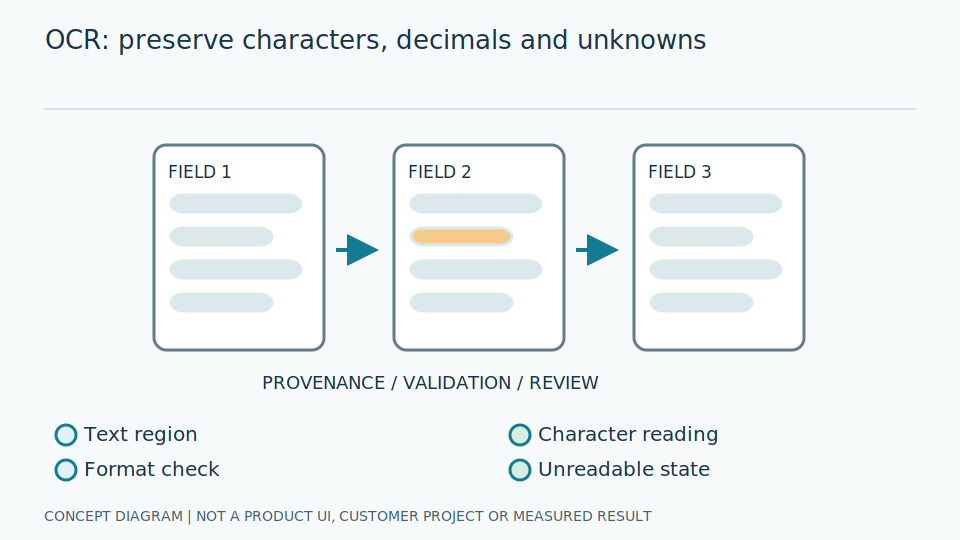
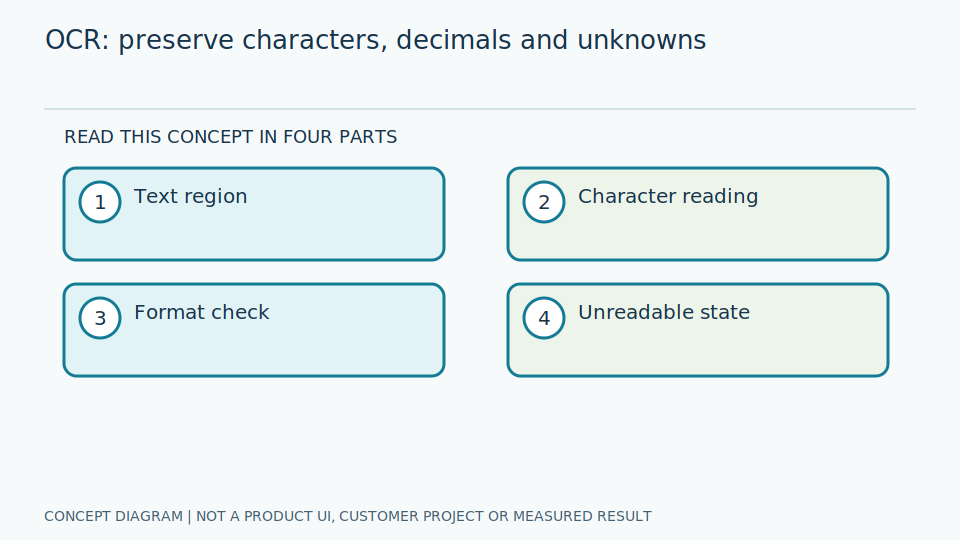
Optical Character Recognition (OCR) separates text localization from character recognition before interpreting values and units. Seven-segment displays may suit dedicated methods better than general text OCR. Decimal points and minus signs are essential parts of a reading.
OCR converts images of characters into usable text, but reading text and understanding an instrument value are different stages. Recognised digits still require a decimal position and applicable unit. Removing small symbols to clean an image can change both magnitude and sign. Their small visual footprint is not evidence that they are unimportant to the measurement.
Define text regions, alignment and accepted formats before converting strings to numbers. Seven-segment displays form characters from fixed illuminated sections, unlike ordinary print. Format checks can reject impossible outputs for a display type but must not supply invisible characters from expected values. Keep raw recognised text and interpretation reasons so reviewers can inspect what came from the image and what came from parsing.
Scroll the diagram horizontally to inspect all details.
Illustrative Industrial Example
Illustrative design scenario: recognize a digital display as "-0.25 MPa", then check its format, unit and display state. If the decimal point is unclear, return no-read rather than silently substituting a plausible-looking number.
Suppose digits are visible but glare hides the decimal point. Inferring the previous value can fail when the process genuinely changes. Show the image and identify the unclear decimal rather than reporting an automatically repaired number. If units are absent, use only a configuration with verified provenance and an explicit scope; never assume the neighbouring display's unit applies.
After perspective correction, check that small dots and minus-sign strokes remain. Test parsing of spaces, units and symbols. Hypothetically, losing the point in 0.25 and reading 25 produces a hundredfold difference, not a minor character error. Engineers therefore need value-and-unit evaluation alongside character recognition, since counting mostly correct characters can hide a consequential numerical result.
Study and Trial Workflow
- 1 Crop and correct perspective without removing small decimal points through excessive filtering.
- 2 Record ground truth as both complete strings and numeric values with units.
- 3 Validate the output schema and send ambiguous cases for human confirmation.
Evaluation and Metric Definitions
Report character error rate separately from complete-field exact match, within-tolerance readings and no-read rate. Recognizing nearly every character can still produce a tenfold error if a decimal point is lost.
Character error rate counts insertions, deletions and substitutions against reference text; exact match asks whether the complete field agrees. State how units and spaces are treated. Compute numerical errors in common units, separately counting strings that cannot be converted. Averaging only parseable outputs may hide the hardest recognition failures and give an incomplete account of usable readings.
Inspect decimals, minus signs and similar digits separately, plus blank displays and warning messages. Verify that rejected outputs do not become zero and that reference time matches the image. If several frames are combined, evaluate temporal grouping too: clear-looking composite text may mix different displayed values and describe a number that never existed at any one instant.
Limitations and Failure Cases
Glare, touching characters and display flicker can remove parts of characters. Combining several frames must not mix values captured at different times while the displayed quantity is changing.
Glare can hide strokes distinguishing digits. Aggressive filtering can erase dots, and enlargement cannot restore missing evidence. Dictionary correction can help ordinary text but is unsuitable for changing instrument values. Separate clearly observed results from assumption-dependent ones. Passing a format rule is not grounds for high confidence that a value was genuinely visible.
Range rules catch some errors, but an incorrect number still within range may pass. More checking stages add maintenance and can reject valid unfamiliar strings. Keep new-case tests and a human-review route. OCR also does not confirm the instrument's measurement accuracy: it reads what a display shows under the supplied imaging conditions, rather than independently verifying the physical quantity being measured.
Practical Checklist
- Are minus signs, decimal points and units preserved?
- Is a zero reading distinguished from a blank image?
- Is a reference image available for results requiring review?