
Principles and Suitable Contexts
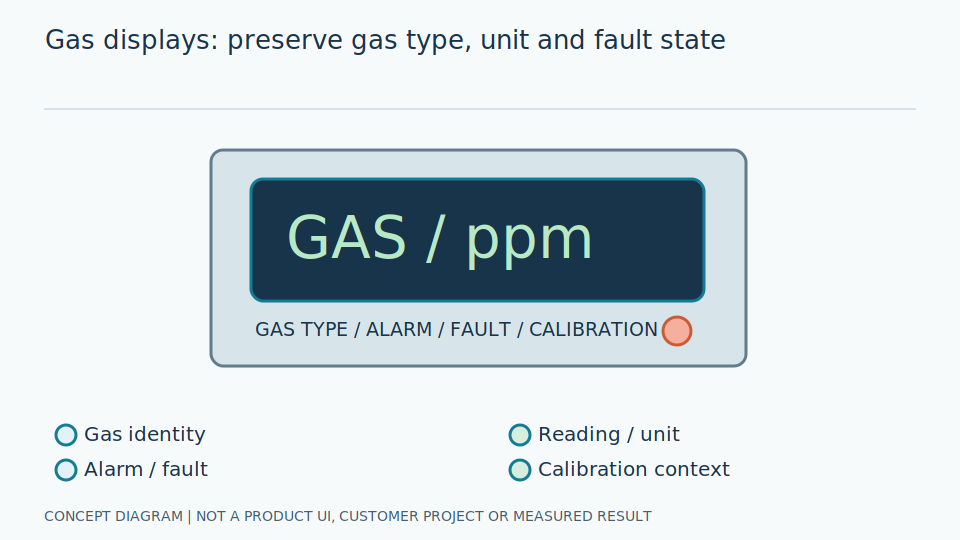
A gas reading needs the gas identity, unit such as ppm, %vol or %LEL, and instrument status together. Those units are not interchangeable without the required conversion basis. Image records can provide supporting information, but cannot replace gas detection systems or determine permission to enter a hazardous area.
Parts per million, or ppm, uses a stated concentration basis; %vol is percentage by volume. Percentage of the lower explosive limit, %LEL, relates to a specified gas and reference basis, not the same gas-volume percentage for every substance. Preserve the channel's gas name and unit. Never guess them from digit position or convert with an undocumented constant, even if the resulting number appears plausible.
Sensor principles and interference vary by model. Image reading follows the sensing layer and cannot correct sensor ageing or unrepresentative sampling. Transmit instrument status as well as value: fault codes matter as much as digits. These observations neither establish atmospheric safety nor replace safety-system signals or entry procedures. A complete image-derived record is supporting evidence, not independent confirmation that the sensor measured correctly.
Scroll the diagram horizontally to inspect all details.
Data and Preparation
Map measurement channels, sensor models, units and fault codes from the manual. Keep calibration and response-test records separate from image-reading results. Test recognition of over-range, warm-up and sensor-fault states using safely collected material under the responsible personnel, without creating an exposure merely to gather images.
Register each channel's gas and whether the screen shows combined, individual or held readings. Responsible personnel should confirm abbreviations and units before automated interpretation. Warm-up indicates preparation, while over-range means the display range is exceeded; neither should become an ordinary numeric value. Use authorised recordings or sample material, not released gas, to obtain test images of states rarely encountered in normal operation.
Retain capture time, instrument position and sensor-replacement history where access is permitted, separately from calibration documentation. The camera must not block sample inlets or instrument access. Define rejection when gas identity or units are incomplete. Ask another reviewer to construct records from the transmitted or resized images, confirming that essential information survives the full image pipeline rather than just appearing in the original.
Failure Cases and Limitations
An ageing or interfered-with sensor may under-read even when the display is read perfectly. A wrong decimal point or gas identity can have serious consequences. Zero on a faulty display is not proof that gas is absent, and the instrument location does not represent every part of an area.
Fault messages may alternate with numbers or replace individual channels. Reading only digit regions can therefore miss instrument malfunction. Filling a missing channel with the previous value falsely implies current measurement. Send unreadable status and the last supported measurement time instead. Users should not need to open the source image to discover a fault, incomplete record or over-range condition concealed behind a normal-looking number.
Exchanged gas identities or units can select inappropriate response criteria, so verify meaning before display or calculation. A low displayed value does not remove existing alarms or testing procedures. Responsible personnel must investigate suspected sensors through approved methods; never create hazardous substances or atmospheres to prove image results. Camera output must not authorise approaching a risk source or entering a potentially hazardous area.
Evaluation Methods
Compare text, status and units with instrument records during authorised testing. Distinguish image-reading agreement from actual gas response testing. Report missed fault and over-range conditions separately rather than hiding them in an aggregate score. A high overall reading score must not become a claim of atmospheric safety.
Reference records must include gas name, value, unit and status for every channel. Independent reviewers should inspect images before system output, separating incomplete page coverage from wrong-channel recognition. Use safely obtained recordings for uncommon critical states. If particular codes lack examples, mark them untested; an aggregate score cannot stand in for demonstrated coverage of every fault code or display behaviour.
Acceptance must verify that fault codes never become zero and over-range never becomes an in-range reading. Include stale images and actual model-specific unit changes. Gas-monitor testing guidance helps distinguish calibration and response testing from image recognition; it does not certify the image system. These results do not authorise entry, establish atmospheric safety or replace the primary alarm and its required response.
Review Checklist
- Store gas identity and unit in every record.
- Do not convert %LEL to ppm without the required basis.
- Store fault as a state, not zero.
- Do not use images for entry authorisation or as the primary alarm.
References and Further Reading
References explain principles, not product certification. Requirements from another jurisdiction do not automatically replace local requirements or the actual equipment manual.