
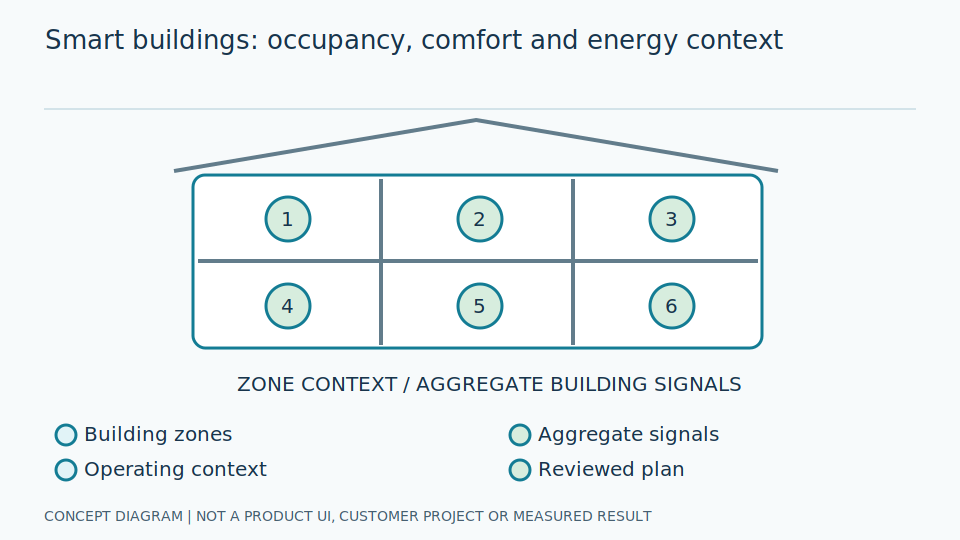
Principles and Suitable Contexts
A BMS combines measurements and controls by zone and system, such as HVAC or energy. It can help examine whether schedules match building conditions. Observing a value does not grant permission to write commands, and a trial must not alter safety systems or escape routes.
BMS means building management system; HVAC means heating, ventilation and air conditioning. A point may contain a measurement, target, command or confirmed state. Separate those categories before combining charts. An on command does not prove a fan or valve operates, and one room's value may not represent a similarly named zone. Point meaning is therefore as important as successful numerical transport.
BACnet defines communication objects and properties under its specifications. Check actual models and implemented features. Aggregation should preserve units, quality and schedule context, beginning read-only. Energy analysis needs building conditions alongside consumption. A familiar standard neither grants control authority nor proves product compatibility; integration must verify the specific point mapping and permissions instead of inferring support from a protocol name.
Scroll the diagram horizontally to inspect all details.
Design and Data Preparation
Create a point list with building, floor, zone, unit, value type and read/write permissions. Check time zones, holidays and equipment schedules. Begin with read-only collection, adding occupancy and outdoor-weather information only as needed for the question, rather than assuming all available context must be collected.
A point list maps system identifiers to human-readable names and locations. Have building personnel verify examples of every type against authorised displays or documentation. Define temperature, energy and gas units separately, never deriving conversion formulas by guessing from names. Preserve relocation history rather than renaming points until old records appear to come from a new location. Historical context should survive registry maintenance.
Check time zones, workdays, holidays and applicable clock changes before combining buildings. Record occupancy context only at the level needed, avoiding excessive personal data. Environmental comparisons need matching averaging intervals and reference-instrument locations. Do not experimentally alter smoke systems, fire protection or escape routes to create examples. The monitoring question must stay within approved access and existing building-operation procedures.
Failure Cases and Limitations
Point names mapped to the wrong rooms lead to analysis of the wrong zone. Different temperature units or daylight-saving changes can distort charts, and one measurement location may not represent an entire area. Energy reductions assessed without indoor air quality can conceal harmful effects.
An unexpected schedule may reflect a holiday or special building use rather than malfunction. Cached values may remain visible through outages, so preserve source measurement time and quality. Incorrect zone aggregation can direct investigation to an unaffected room. Recheck the point registry before inferring a cause from a graph; accurate numbers under the wrong room label still produce a misleading operational conclusion.
Lower energy totals can reflect weather or changed activity, not the trial measure. Totals alone may hide unsuitable environmental periods. Report comfort and air-quality quantities alongside energy. Command changes must follow responsible personnel and building procedures, never occur implicitly through monitoring software or interfere with protective functions. Data access gives evidence for a review; it does not grant authority to alter operating schedules or controls.
Trial and Evaluation Methods
Perform point-to-point checks against local displays and point documentation. When comparing energy use before and after a change, account for weather and building use. Report comfort conditions and missing data as well. Do not infer savings from totals drawn from different seasons without accounting for context.
Point-to-point checking verifies each source-to-destination association. Independent reviewers should confirm location, value type, units and time, not just plausible numbers. Include absent or bad-quality points to prove that status survives transport. If actual inspection of some points is not authorised, mark them unverified rather than allowing successful checks elsewhere to stand in for their missing evidence. Coverage matters separately from agreement on tested points.
Acceptance should separate integration correctness from building-use analysis. Before-and-after comparisons need an explicit context-adjustment method, remaining confounders, missing-data intervals and changed environmental conditions. BACnet and air-sensor references help organise meaning and checks; they do not certify savings, product support or building health compliance. State what was verified and what remains an analytical interpretation requiring additional evidence.
Review Checklist
- Maintain a point list with zones and units.
- Start with read-only access.
- Verify schedules and holidays.
- Assess energy alongside environmental quality.
References and Further Reading
References explain technology principles or requirements. They do not establish product certification or support for every requirement.