
Content Level: Overview / Implementation considerations
Principles and Suitability
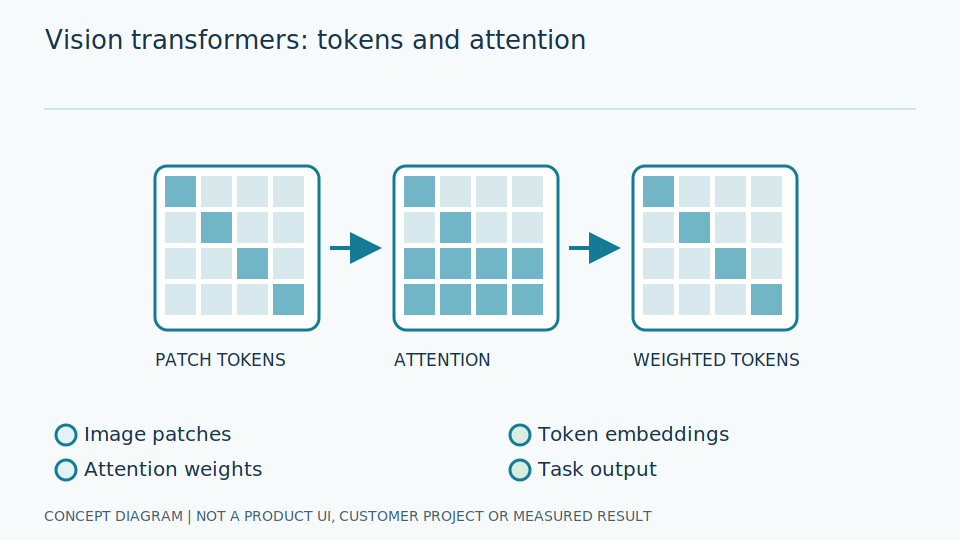
A Vision Transformer divides an image into tokens and uses attention to connect information across positions, unlike the local inductive bias of CNNs. Standard attention cost grows quadratically with token count, although window-based architectures may behave differently.
A token represents an image patch, not a word understood in a human sense. Attention mixes information from positions using calculated weights, potentially incorporating broad relationships between pointers and scales. It still needs relevant training and answers. Connecting positions does not automatically establish the meaning of measurement units or the correctness of a scale interpretation.
Inductive bias means structural assumptions constraining learning: CNNs emphasise nearby regions, while transformers connect information differently. Check patch size, positional encoding and input shape for the chosen version. Large patches reduce token counts but may blend thin pointers with backgrounds. Evaluate actual critical details rather than assuming that overall image dimensions establish sufficient task information.
Scroll the diagram horizontally to inspect all details.
Illustrative Industrial Example
Illustrative design scenario: compare a transformer and a CNN for identifying dial components that need broader visual context. Use the same data and memory limits instead of assuming that transformers are always better.
Suppose several pointers and a label help distinguish components. Broad context may help, but labels correlated with answers only in training can become misleading shortcuts. Test new dials and unclear labels. Seeing wider context does not guarantee understanding of scales or selection of the correct pointer without appropriate supervised evidence and independent evaluation.
Check whether critical patch details still influence results. Compare methods on identical splits with transparent training budgets. A fixed-shape exported model needs checks against silently receiving incompatible shapes. Compare reference predictions before and after export, including supported operators. Equal file formats do not guarantee identical computation, so compatibility and numerical agreement both need testing on the actual runtime.
Study and Trial Workflow
- 1 Choose a patch size that preserves the pointer details needed by the task.
- 2 Review pretraining data and adapt fine-tuning to the actual dataset.
- 3 Export the runtime and test operator compatibility and input-shape support.
Evaluation and Metric Definitions
Compare task metrics, latency and peak memory at equal image resolution. Include learning curves at different dataset sizes and results on a new domain, rather than judging the architecture by a single benchmark.
Task metrics answer the operational question, such as angle errors or region quality. Peak memory is maximum usage during execution; report concurrent-image counts and dimensions with it. Small-image measurements do not describe the burden of larger operational inputs. Separate architecture effects from differences in pretraining and preparation, or apparent architectural advantages may actually come from unequal experimental conditions.
Inspect target-size groups and small-data cases with learning curves to distinguish memorisation from insufficient learning. Measure the actual exported path, including token preparation and output delivery rather than convenient training-machine intervals. If increasing resolution sharply raises memory, inspect token counts and attention type before adding hardware. Preserve all conditions for repeatable comparison.
Limitations and Failure Cases
Large models consume substantial resources and may be sensitive to small datasets. Attention maps are not causal explanations or evidence that a model understands the scale printed on an instrument.
Attention maps show weights used to mix information in part of a model, not a complete explanation of final correctness. High-weight regions can be distractors. Investigate with verified answers and appropriate input changes rather than interpreting a map as proof that the model follows physics or understands units in their human meaning.
More tokens may retain detail while rapidly increasing standard attention computation. Windows restrict connections and introduce version-specific tradeoffs. Choose against actual results and resources, not universal claims of superiority. Model documentation guides experiments and limitations; it does not assert current product capabilities or operational results unsupported by application-specific tests. A published architecture description is a starting point for assessment, not an installation acceptance report.
Practical Checklist
- Is token size appropriate for the target details?
- Are baselines compared with similar training budgets?
- Does the hardware support the operators needed by the exported model?