
Principles, Scenarios and Suitability
Image-based PPE screening checks equipment visibility in defined areas. It does not confirm fit, material condition or protection level. Use it to assist review, not to infer violations when equipment is obscured, and never infer sensitive personal traits from images.
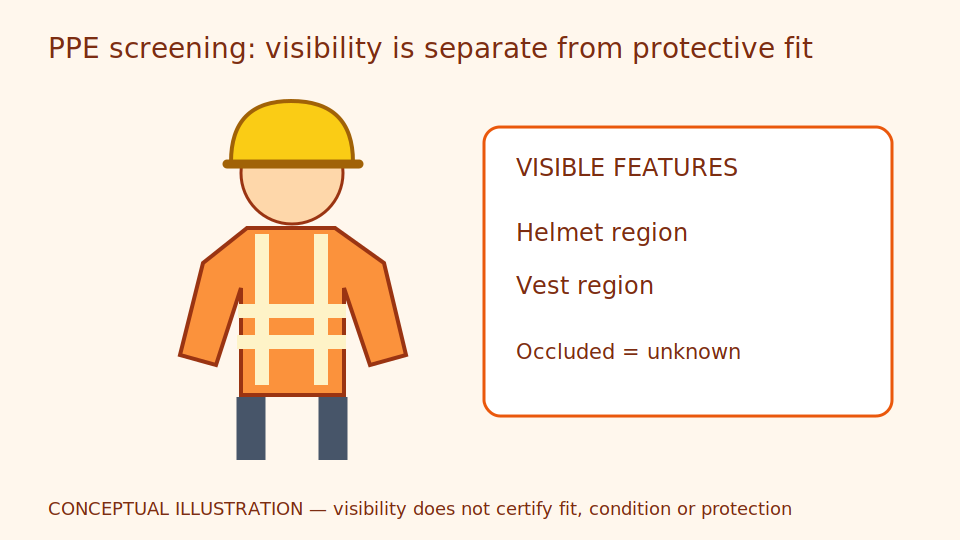
PPE means personal protective equipment, such as helmets or glasses. Seeing a helmet-like object differs from confirming its correct type and fit. Results mean visible, not visible or uncertain equipment only within the inspected area. Someone facing away or obscured should not be classified as not wearing equipment. Support fair communication and on-site checks rather than adjudicating wrongdoing.
Engineering must associate requirements with each area's risk assessment, not apply one rule everywhere. Higher sensitivity may create more occlusion events and review work. Evaluate misses and false alerts, with dismissal and appeal routes. Privacy protects data and rights through framing, retention and access design from the start. Do not add identification when area-level information suffices.
Scroll the diagram horizontally to inspect all details.
Illustrative Design Scenario
Illustrative design scenario: an entrance image flags a helmet that may not be visible for staff to check in person. The reviewer may find camera-angle occlusion and dismiss the event without automatically creating a violation record.
Suppose people pass together and obscure the helmet of someone behind them. Report incomplete visibility for staff review, not a non-wearing record. Alternatives include improving camera angle or observing a less crowded area, but must not obstruct movement or change emergency escape routes merely to simplify images.
An on-site reviewer may find a new helmet design unfamiliar to the model. Confirm its type and requirements before adding reference data; colour alone cannot establish normality. Test with authorised data or demonstrations in safe areas. Never ask people to remove PPE in hazardous areas to create negative examples, or connect scores to automatic punishment.
Inputs and Prerequisites
Use area plans, PPE requirements from risk assessment, camera angles and occlusion examples. Define the basis for processing, notices, retention and restricted image access before collecting personal information.
Retention is how long data is kept and must relate to its purpose. Keep only necessary images and event information. Do not link names or personal histories when area inspection assistance does not need them. Assign responsibility for requests to correct results.
Results should show observed equipment type, area, time and uncertainty with limited images. They must not score health, emotion or personal trustworthiness: this image task cannot support those conclusions.
Trial and Integration Workflow
- 1Define visible coverage and cases that must remain uncertain.
- 2Check PPE visibility without identifying people beyond what is necessary.
- 3Require human confirmation and a safety response without automatic punishment.
Evaluation and Acceptance Criteria
Measure missed PPE and false alerts per operating period by angle, occlusion and equipment type. Assess reviewer workload and appeal routes. Good results on clear images do not establish performance in crowds or with new equipment designs.
Evaluate continuous events so multiple frames do not inflate one alert into many. Verify reviewers have enough evidence and can dismiss false events. Check deletion when the stated retention period ends.
Have affected people trial appeals and unconfirmed statuses. Record corrections without preserving the original allegation as a violation history. System quality includes effects on rights and human workload, not image classification scores alone.
Scroll the diagram horizontally to inspect all details.
Failure Cases and Limitations
Cameras cannot check respirator seals or material properties. Alerts are not certified protective functions and do not replace training or supervision. Scores must not be treated as proof of wrongdoing or used to infer health or sensitive traits.
A protective function reduces hazards and requires specific design and evidence. Image alerts do not demonstrate that function. Keep primary measures and supervision; absence of an alert must not authorise entry.
PPE standards guide equipment selection, not certify wearing from images. Additional detection types need real assessment and communication as future proposals, not claims of support for every item or existing safety certification.
Practical Checklist
- Are false positives reviewed before any action is taken?
- Are images and identifying data limited to what is necessary?
- Do primary protective measures remain independent of cameras?