
Content Level: Overview / Implementation considerations
Principles and Suitability
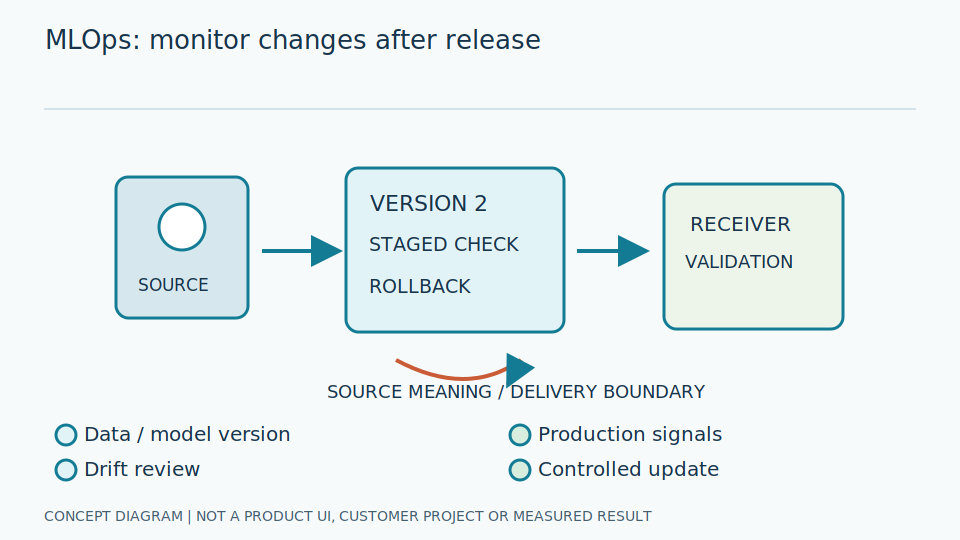
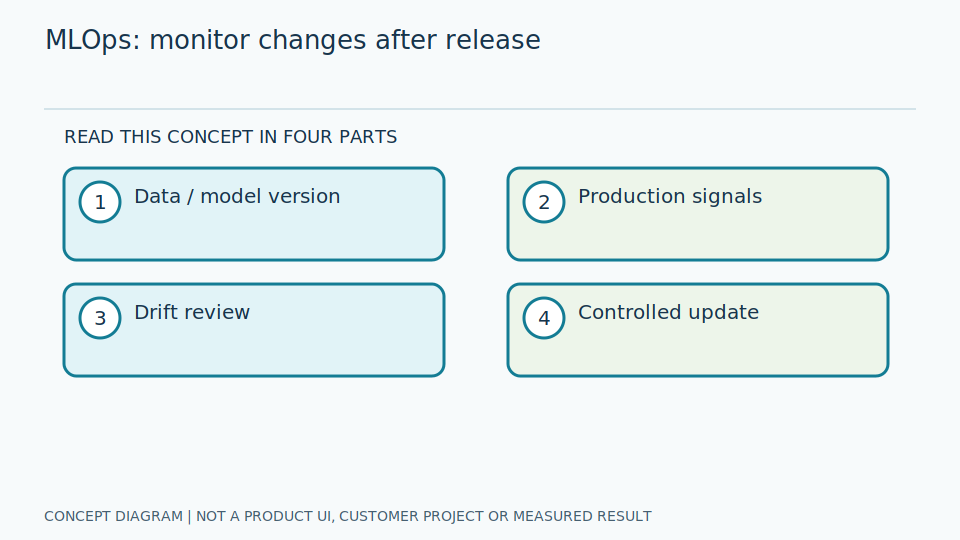
MLOps links data versions, models, installation, and operational outcomes. Data drift means changed input distributions; confirming performance drift requires reference answers. Drift is not an instruction to retrain and release automatically. Monitoring must distinguish an observed change from a verified loss of task quality, with responsibilities for investigating and deciding what action is warranted.
After installation, know which data and version produced each result rather than only whether a service remains running. MLOps coordinates development and operations. Drift refers to defined changes in data or outcomes: darker images can alter distributions while remaining readable. Separate detection of change from confirmation of deterioration, rather than treating one warning type as an immediate reason for releasing a new model.
Engineers attach data, model, calibration, and schema versions to results, defining metrics and alert recipients. A model registry manages version information under a chosen process; it does not automatically approve versions. Separate storage, approval, and release. Use reference answers from checks independent of model scores, preventing feedback from selecting only cases in which the system was already confident.
Scroll the diagram horizontally to inspect all details.
Illustrative Industrial Example
Design example: an increase in no-read results from one camera prompts inspection for lens contamination before retraining, because the cause may be equipment rather than an outdated model. Monitoring should direct investigation with images and configuration evidence, not assume that every deterioration requires a new learned model instead of a correction elsewhere in the system.
Suppose haze obscures the needle in one camera while others remain normal. Training on hazy images may not recover missing detail and could encourage acceptance of images that should be rejected. Personnel should inspect equipment through suitable procedures and compare source images before and after correction. Increased errors can also arise from reference answers, camera settings, or units, not simply model age.
Engineers inspect random readable and unreadable samples with versions from before the problem. Retraining must pass separate data, reference, testing, and approval stages before release within the defined scope. Test rollback of paired models and mappings, avoiding silent use of old versions with new schemas. Verify that queued and historical results remain traceable to their versions after a switch.
Study and Trial Workflow
- 1 Record model, data, and calibration versions with results and events.
- 2 Monitor low-quality images, out-of-range values, drift, and human review outcomes.
- 3 Have task owners approve retraining, testing, and renewed rollout as separate stages.
Evaluation and Metric Definitions
Measure detection time, false-alert rates, and actual quality from randomly reviewed examples. Test rollback and verify tag and schema compatibility. Operational monitoring needs evidence about the problems found and the burden of its warnings, not merely a count of alerts or a display showing that the service continues to respond.
A false alert requires no correction under the task's definition. Report these alongside real incident counts and observation time to show personnel workload. Ground truth is a verified reference answer and may arrive later than model output; state that delay and groups lacking answers. Few alerts cannot establish quality when monitoring misses relevant problems or warning criteria are too weak.
Engineers test alert rules with simulated known causes, checking that recipients have sufficient diagnostic information and assigned follow-up duties. Separate poor-image quality from wrong readings on good images. Verify sampled results' artifact traceability and compatibility after rollback. NIST frameworks help organize risk and roles, not demonstrate certification or an already implemented complete automatic management cycle.
Limitations and Failure Cases
Without continuous ground truth, actual quality can become known only after a delay. Keeping only images the model considers confident biases feedback. Monitoring must therefore acknowledge unverified outcomes and sample-selection rules, rather than treating a favorable selected collection or a quiet alert dashboard as evidence that the entire operating population remains adequately handled.
Alert-only feedback can miss wrong predictions that trigger no warning. Sample normal cases too and disclose what quality cannot be verified. More retained images aid analysis but add storage and personal-data risk, requiring retention and access policies. A dashboard cannot replace accountable personnel interpreting warnings or correcting equipment causes; recorded indicators still need an owner capable of acting on the evidence.
Frequent retraining and release increase verification work and version-mismatch opportunities. New data is not automatically suitable for training, and high drift scores need not immediately change the model. Maintain baselines and stopping criteria. This management lifecycle does not confirm current automatic registries, retraining, or rollout in a product; citing risk-management guidance does not assure quality under every operating condition.
Practical Checklist
- Who receives alerts and approves releases?
- Is data that is not forwarded also monitored?
- Can every result be traced to its producing artifact?