
Content Level: Overview / Implementation considerations
Principles and Suitability
Self-learning can refer to self-supervised learning, pseudo-labeling, or continual learning, which are different processes. Collecting feedback is not retraining, and retraining is not approval for deployment. The term should identify what actually happens rather than suggest that every new image immediately improves a running system, changes its weights, or establishes that the revised behavior is ready for consequential operational use.
Self-supervised methods derive training tasks from data structure; pseudo-labeling uses predictions as labels; continual learning extends learning to new tasks. They need different checks. Collecting unreadable images merely gathers evidence and does not automatically improve model outputs. A system described as learning by itself still needs explicit definitions of data handling, training changes, and verification, so users can distinguish passive collection from a genuine approved change in behavior.
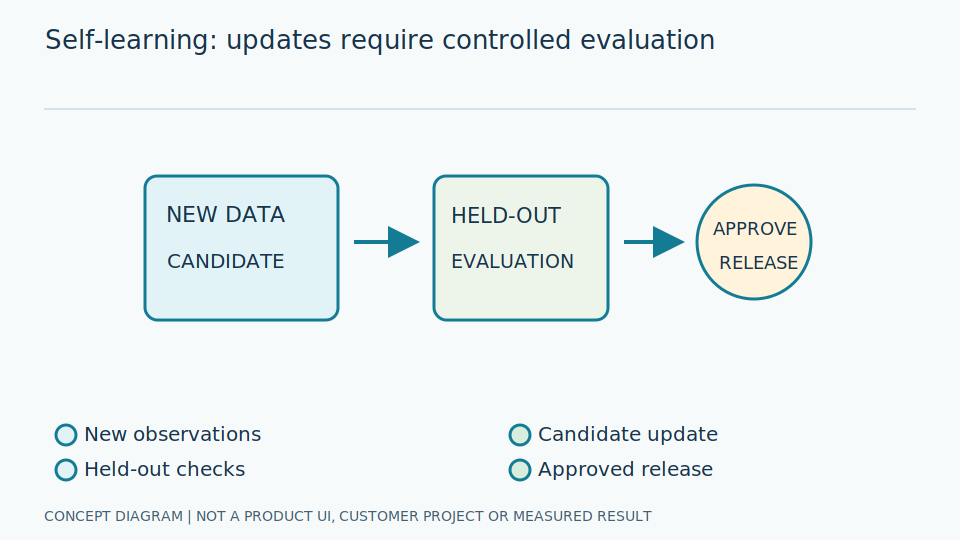
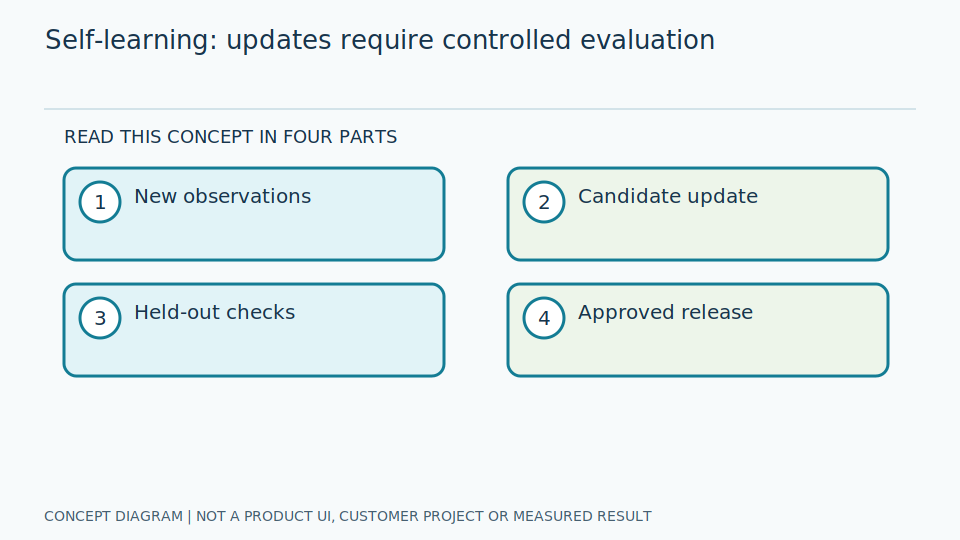
Engineers separate feedback, label verification, candidate training, and release approval. New data requires versions and use rights, with tests independent of the previous model's label selection. Unchecked predictions can reinforce mistakes. Establish gates before behavior changes and keep production versions locked, preventing collection activity from silently changing operating outputs before acceptance testing. Approval should address the actual candidate and related configuration rather than the vague promise of ongoing adaptation.
Scroll the diagram horizontally to inspect all details.
Illustrative Industrial Example
Design example: collect no-read images for expert labeling and train an offline candidate while production weights remain unchanged during gauge reading. The improvement path is explicit and controlled, distinguishing evidence collection from model modification. A new candidate can be investigated without implying that the currently operating reader is updating itself or that each collected failure has already become a reliable training answer.
Suppose new images show a gauge type the old model cannot read. Experts should verify visible needle tips and units before labeling, not copy the old model's guesses and rename files. If glare hides evidence, mark no-read or correct acquisition through approved procedures rather than teach confidence in incomplete images. Do not train on the old evaluation images and continue claiming the resulting test score is independent.
Engineers create a new approved dataset version and train offline without changing production. Compare new and previously successful groups, checking calibration, mappings, and schemas before release and testing whole-package rollback. A candidate helping one group while harming another requires task-based acceptance decisions. Recent data is not automatically more important than the reliability of existing tasks, and the result needs evidence across both rather than only the newly collected examples.
Study and Trial Workflow
- 1 Separate verified feedback from model guesses.
- 2 Create a new dataset version and run regression checks on existing tasks.
- 3 Obtain task-owner approval for the candidate and roll out with rollback.
Evaluation and Metric Definitions
Evaluate new and existing groups for catastrophic forgetting, pseudo-label error rates, and test contamination through feedback. Training success on the new examples alone does not demonstrate a valid improvement. The evaluation must preserve independent evidence and reveal whether adaptation harms previously accepted behavior, rather than describe additional files or favorable candidate outputs as automatic proof of better operational quality.
Catastrophic forgetting is degraded old-task performance after learning new information. Maintain regression collections alongside newly added groups instead of evaluating only images already used for candidate training. Estimate pseudo-label error from human-confirmed samples and report labels still unknown. More files do not necessarily mean more reliable information, particularly when uncertain predictions are accumulated as answers and the same mistakes can propagate through later training rounds.
Engineers inspect manifests and feedback history for test-to-training leakage within the declared scope. Lock acceptance criteria before candidate evaluation, then check exported artifacts and rollback using reference images. When performance declines, review labels and data proportions before insisting on more training. Registries and risk frameworks organize the process; they do not establish ready-to-use self-learning or certify that a candidate is acceptable merely because it has been registered.
Limitations and Failure Cases
Confirmation bias can amplify existing mistakes, and ungated online learning can change behavior that has never been accepted. In this feedback loop, selecting labels that the old model believes can preserve its blind spots. Examine confident and uncertain cases rather than treating confidence as verification, because wrong but confident outputs may otherwise become the strongest repeated teaching signal for the next model version.
Online learning increases responsiveness to recent data but risks changes during operation. Provide accountability and stopping criteria rather than claiming that adaptation removes testing needs or risks from wrong labels and out-of-scope data. Collection and training remain separate activities requiring quality checks. A model's ability to change does not prove that the change is beneficial, and a stream of feedback does not independently establish the truth of its contents.
Continuous collection aids review but adds storage, permissions, and labeling work. Define retention and purposes before training use. This guide proposes an approved improvement cycle, not current product online learning or automatic retraining. Release approval must consider data, model, configuration, and downstream results together. Self-learning must not become a guarantee of automatic quality gains across every condition or a justification for avoiding independent acceptance checks and accountable version management.
Practical Checklist
- Is the learning process actually used clearly defined?
- Who verifies labels and approves releases?
- Can both models and data be rolled back?