
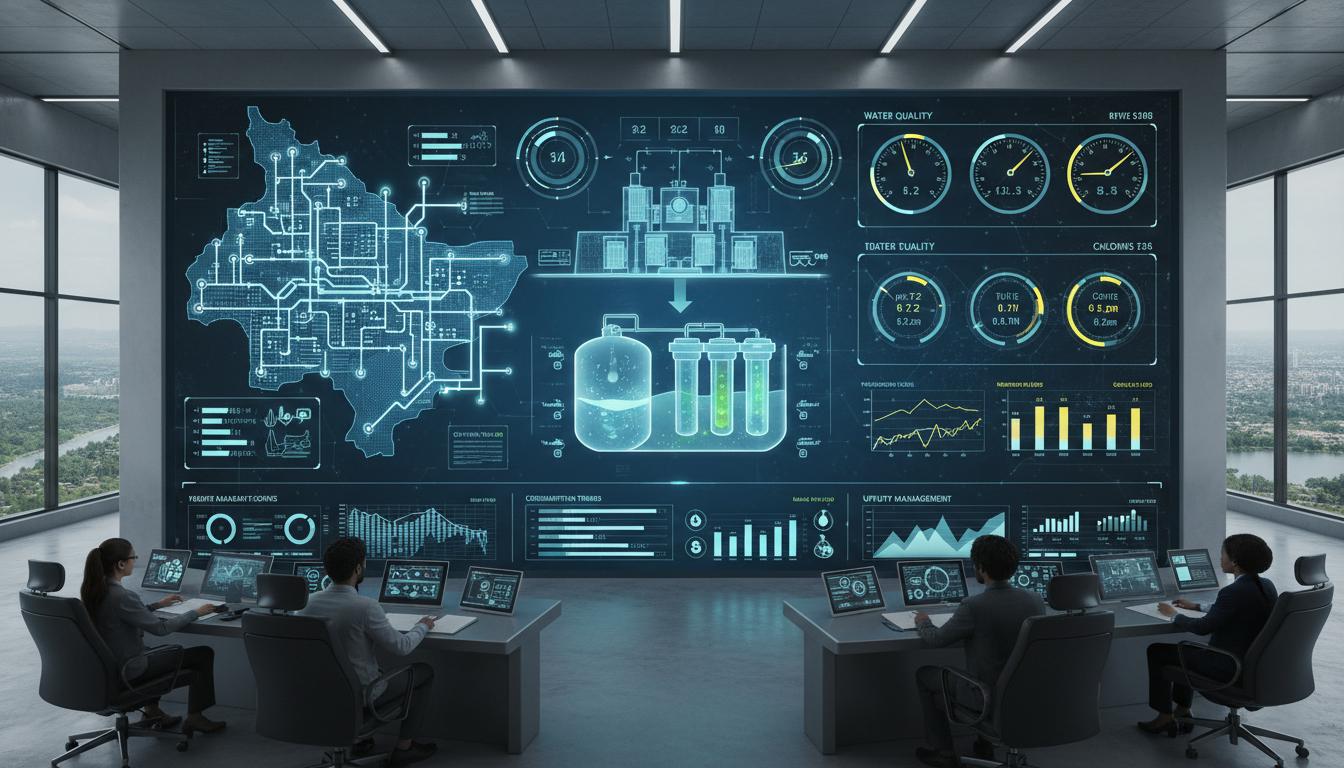
Principles, Scenarios and Suitability
Water management uses a volume balance across supply, consumption, storage and losses. Distinguish instantaneous flow from cumulative meter readings. Monitoring can help investigate out-of-hours use and leaks, but a difference between totals does not always prove a leaking pipe.
Imagine a tank filling and emptying simultaneously. Water entering in excess of measured consumption may be stored rather than lost. Flow describes how quickly water passes; a cumulative reading describes volume since a starting point. Include storage changes and planned use such as cleaning before attributing a difference to leakage.
The balance boundary defines which incoming and outgoing flows are counted. The residual is what remains after known components are included. Submeters reduce unknowns but add calibration and time-alignment work. Begin where piping is understood and accessible to inspection. Results should prioritise checks, not command valve closure from an unexplained difference, especially for critical process supplies.
Scroll the diagram horizontally to inspect all details.
Illustrative Design Scenario
Illustrative design scenario: examine flow while production is stopped, comparing it with tank levels and cleaning schedules. Continuing flow prompts a valve and pipe inspection round; a model should not shut off supply without an assessment of the consequences.
For illustration, 100 cubic metres enter, 80 are consumed at metered points and storage rises by 15. The residual is 5, not 20 cubic metres. It still includes meter uncertainty and unmetered consumption. Check cleaning records and readings before calling the residual a leak.
Operators could survey use during a planned stop or add a meter to a suspected branch. Surveys require labour; meters support ongoing observation but must suit pipe and flow range. Technicians should confirm the layout and reserve-water requirements before changing operation. Do not cause water deprivation to test an alert.
Inputs and Prerequisites
Use piping diagrams, meter boundaries, tank levels and geometry, process water-use schedules and pump states. Verify units, pulse multipliers and cumulative-counter rollover before combining totals.
A pulse represents a counted increment of volume; state the volume per pulse. Tank level does not directly equal volume if the cross-section changes. Use geometry or a level-to-volume table confirmed by the tank owner rather than assuming a constant area.
Show incoming volume, consumption, storage change and residual for matching intervals. If tank level is missing, label the balance incomplete. Filling storage change with zero merely to keep a report calculating would convert missing information into an apparently measured result.
Trial and Integration Workflow
- 1Define the balance boundary and identify flows that are not yet metered.
- 2Align meter times with tank-level changes and cleaning activities.
- 3Develop anomaly criteria for each operating period and verify findings in the field.
Evaluation and Acceptance Criteria
Compare cumulative volumes with reference measurements and examine water-balance residuals with uncertainty. Test day boundaries, counter rollover and missing-data periods. Alert criteria should not create nuisance events from water use that was planned.
Check periods of low and high flow where references can safely be obtained, because meter behaviour may vary across its operating range. Test register rollover with simulated data. Do not alter a live counter without an approved, recorded procedure.
Water-system staff should compare warned intervals with real activity logs and sample unwarned intervals too. Report residuals alongside components still lacking meters. This makes clear which physical area and conditions the conclusion covers, rather than implying that the whole site has been accounted for.
Scroll the diagram horizontally to inspect all details.
Failure Cases and Limitations
Reading a meter does not measure water quality. Water retained in pipes, transmission delays and unknown tank geometry can create differences in totals. Water-quality and safety work require suitable sampling methods and instruments assessed separately from image reading.
Separate recirculated water from new supply or the same water may be counted repeatedly as new consumption. Changed pipe routes or an opened bypass invalidate the old balance. Update the diagram and reconcile totals again before continuing comparisons.
Water reduction must not compromise hygiene, cooling or fire protection. Responsible personnel must review conservation proposals against these duties. Volume information is not assurance that water is drinkable or compliant with a requirement, and unresolved losses must not justify interrupting essential supply.
Practical Checklist
- Are tank-level changes included in the balance?
- Is planned consumption distinguished from leakage?
- Can readings be verified against a reference instrument?