
Principles and Suitable Contexts
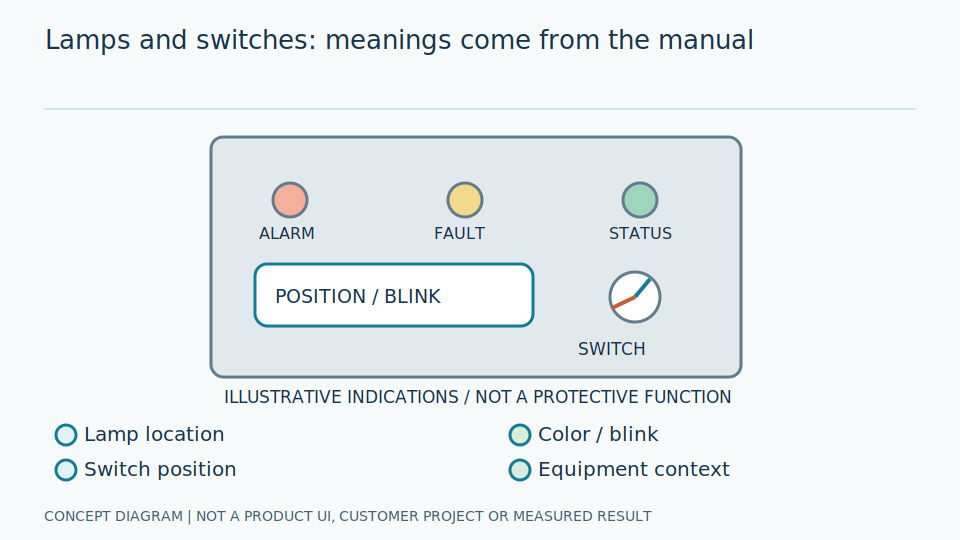
Distinguish on, off, blinking and unknown states while reading the associated label. Green may indicate ready or running, depending on the circuit. Image classification suits identifiable lamp locations and documented blink patterns. A switch appearing in the on position does not prove that its electrical contacts are closed.
Lamps form a language defined by the panel designer; switches indicate commands or mode selections. Read their labels before interpreting colour. Blinking is a time pattern, not something established by one photograph of an unlit lamp. Use a sequence containing lit and dark phases, and distinguish an invisible lamp from one whose off state can actually be confirmed by the available view.
Visual classification may compare brightness and colour with the background, but external lighting can alter both. Position-specific criteria can be more useful than one colour rule for the entire panel. Store the observation, such as lamp illuminated or handle position, separately from process conclusions such as machine running. This avoids passing along certainty beyond what the visible indication and documented circuit meaning support.
Scroll the diagram horizontally to inspect all details.
Data and Preparation
Register each lamp, colour, documented meaning and blink period. Capture both lit and unlit conditions under different ambient light levels. For blinking, choose an observation interval that captures the pattern without interfering with operation, and retain sequences rather than relying solely on separately labelled still photographs.
Map positions and the names operators actually use, including labels for all permitted switch positions. Include daylight and room-light conditions without operating machinery or switches just to generate states. Ensure the view shows labels and handle shapes while leaving access clear. Installation should not make the camera appear to be a control device or interfere with the operator's normal use of the panel.
Define the confirmation window from documented blinking patterns and retain each image's time. With irregular sampling, use actual elapsed time rather than frame count. Test automatic camera brightness adjustment that may react when a lamp lights. Decide whether to fix exposure or evaluate brightness relative to neighbouring regions, based on verified conditions rather than assuming one configuration will suit every lamp.
Failure Cases and Limitations
Reflected ambient light can resemble an illuminated lamp. A failed bulb can be mistaken for a stopped machine. Periodic sampling can repeatedly coincide with the dark phase and miss blinking entirely. Use image sequences and distinguish a failed indicator from the underlying process state it is intended to represent.
If several lamps unexpectedly appear lit together, examine overexposure and reflections before inferring a panel event. Skipping blink phases can make a lamp look continuously on or off; that is a sampling effect, not necessarily circuit change. Identify sequences too short to establish state and never fill them from previous images without a stale-data flag visible to the user.
Some switches return mechanically after a command while the circuit state persists. A handle image therefore shows its photographed position, not complete command history. When lamps conflict with machine records, refer the discrepancy to responsible personnel for indicator and circuit checks. Do not use images to judge safety or permit starting, and never delay an existing required response while awaiting image confirmation.
Evaluation Methods
Build a confusion matrix for on, off, blinking and unknown. Separate results by lamp and lighting condition. Evaluate event detection over a complete observation interval, including time needed to confirm state, instead of counting only correctly classified individual frames. Check whether sampling conceals short or recurring events.
A confusion matrix shows which real states become which reported states, exposing blinking misread as off or reflections misread as on. Reviewers should inspect the same sequence and identify insufficient evidence. Do not directly use machine commands as lamp reference labels: the lamp may fail despite a successful command. Keep image labels distinct from independently verified circuit records for an interpretable comparison.
Accept by lamp and important state rather than averaging easy lamps over difficult ones. Report blink-confirmation time and image gaps alongside accuracy. Recheck the map after lamp-colour, label or camera-angle changes. Control-system references help define the limits of conclusions; they do not assign the camera a safety function or provide safety certification through a successful classification experiment.
Test adjacent lamps whose glow spills into neighbouring positions, checking whether results remain attached to the correct name. Correct colour and brightness on the wrong lamp still convey the wrong meaning. Retain the images establishing spatial association with each lamp's test results, so reviewers can trace whether an error involved state recognition, position mapping or both.
Review Checklist
- Use the actual panel colour definitions.
- Test reflections and failed bulbs.
- Define the observation period for blinking.
- Do not infer safety from colour alone.
References and Further Reading
References explain principles, not product certification. Requirements from another jurisdiction do not automatically replace local requirements or the actual equipment manual.