
Principles and Suitable Contexts
Remote monitoring connects measurements, interpretation and responsible people. It suits supplementary observation when an on-site verification path exists. Seeing a value on a dashboard does not establish that equipment is currently normal, and monitoring is not equivalent to having permission or capability to control equipment remotely.
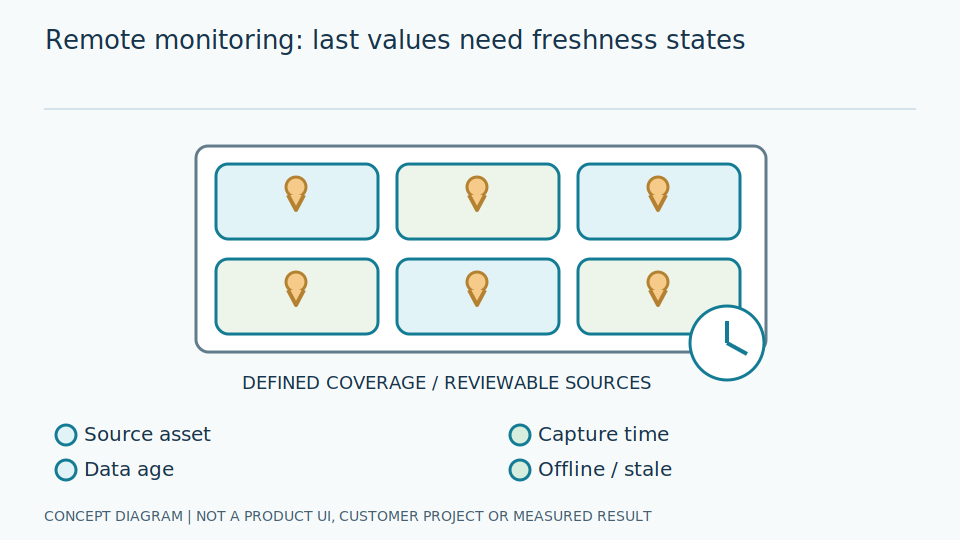
Fresh data means age appropriate to the question, not a recently opened screen. An alert is an observation requiring review; acknowledgement means someone accepts work under the procedure, not that resolution is complete. For AI-derived results, show units, provenance and limitations. Colours and confidence scores must not make users mistake an interpretation for independently confirmed physical conditions or completed incident handling.
An event chain includes measurement, transmission, processing, notification and human verification, each with potentially different delays. Preserve those stages and plan backup communication. Monitoring is supplementary rather than a control circuit. Safety instrumented systems, interlocks and emergency shutdown must not wait for dashboard or mobile responses to fulfil their duties. Reporting clear stages also prevents communication success from being misrepresented as a safety response.
Scroll the diagram horizontally to inspect all details.
Design and Data Preparation
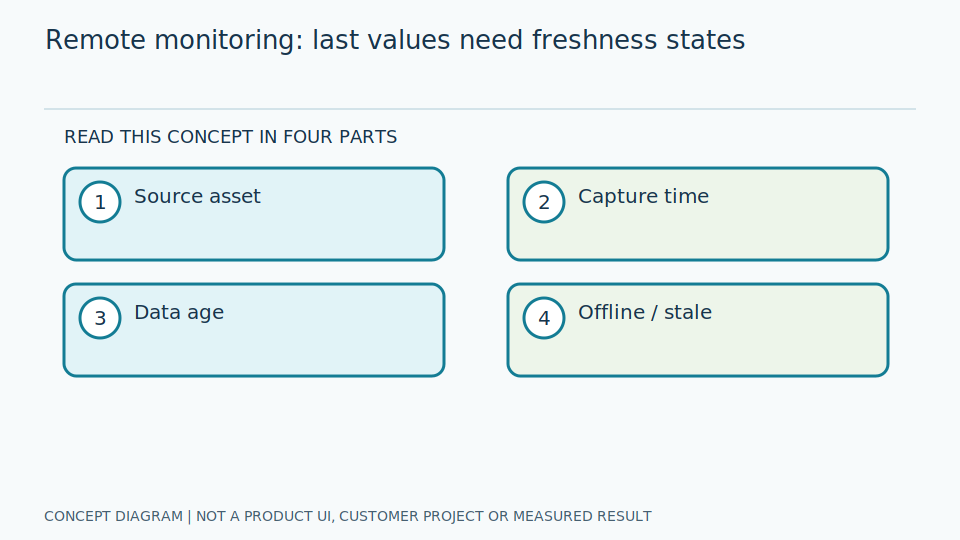
Define maximum data age for the process. Display the latest measurement time and receipt time. Assign event recipients, a backup channel and a verification procedure. Separate missing-data alerts from process-value alerts. Do not make emergency shutdown depend on an image feed or internet connection.
List important points and people who can actually verify them. Define how expired readings appear and who handles missing-data events; do not display green when new measurements are absent. Age limits should follow the question and sampling interval rather than one universal number. Let users distinguish current, stale and unknown examples before the trial, checking comprehension instead of assuming timestamp labels are sufficient.
Document receipt, escalation and verification steps, including shift handover. Separate viewing rights from task-closing rights and retain stage timestamps. Restrict image evidence access while preserving units and traceable identity. Prepare backups under organisational procedures without assuming cloud or push delivery always succeeds. The ability to view a remote status does not implicitly expand authority to issue machine commands or change operational settings.
Failure Cases and Limitations
Successful notification delivery does not mean someone has taken responsibility. Repeated alerts can hide important events, and outages affecting both the measurement site and viewer may prevent a response. Provide escalation and record an unknown state explicitly instead of replacing uncertainty with a green normal indicator.
Alerting on every record can overwhelm recipients, requiring grouping and escalation rules that retain important changes. Excessive grouping can instead hide distinct problems at several points. Keep event identifiers, times and point-specific owners. Message counts prove neither monitoring coverage nor successful response: inspect whether an appropriate person accepted each event and whether its verification step actually occurred under the defined procedure.
Historical data arriving after reconnection can trigger apparently current alerts. Separate event time from receipt time and identify retrospective review. Shift changes need transfer of unfinished work rather than acknowledgement tied only to a previous user's account. On-site verification and response retain established procedures; viewers must not experimentally operate machinery to resolve suspicions drawn from an image or chart.
Trial and Evaluation Methods
Rehearse events using clearly labelled simulated or replayed data. Measure event-to-notification, acknowledgement and verification times separately. Test night-time or shift-change scenarios under authorised procedures. Record duplicate alerts and events without an assigned recipient, rather than treating message delivery as proof of a completed response.
Replay uses recorded data to exercise a workflow; label it so recipients do not mistake it for a live event. Use known times and states, with independent checks of creation, escalation and closure. Include successful delivery without acceptance and missing-data events distinct from process anomalies. These cases demonstrate that the workflow does not substitute connectivity for measurement quality or dispatch for human responsibility.
Acceptance should cover understandable data age, assigned owners and events still awaiting verification. Report each delay with shift and communication context, not as an SLA or emergency-delivery guarantee. OT and AI-risk references help structure oversight and limits; they do not approve monitoring for safety functions. Rehearsal results do not replace testing of the original emergency circuits or establish their protective performance.
Review Checklist
- Show data age at every important point.
- Assign ownership and escalation paths.
- Test missing data and undelivered notifications.
- Do not replace SIS, emergency circuits or interlocks.
References and Further Reading
References explain technology principles or requirements. They do not establish product certification or support for every requirement.