
Content Level: Overview / Implementation considerations
Principles and Suitability
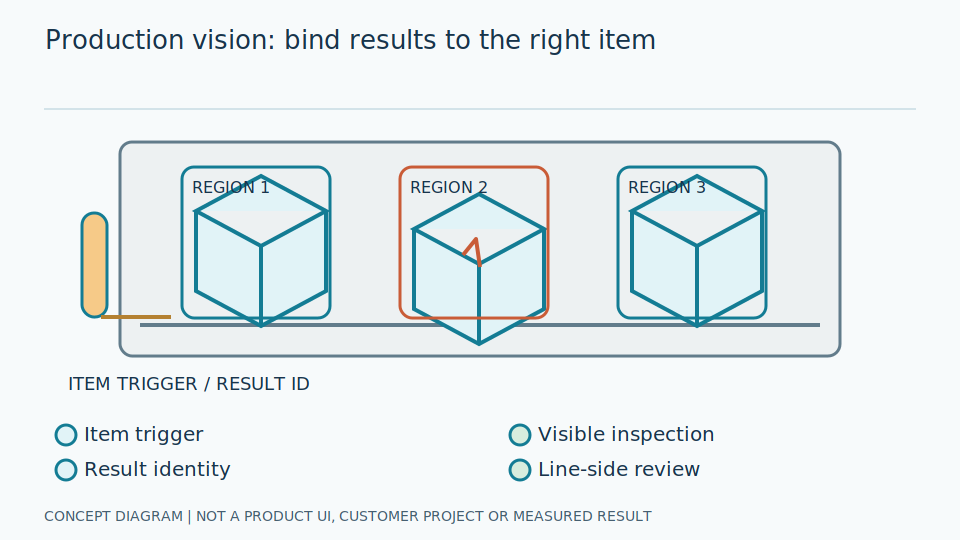
Production-line AI must coordinate the inspection trigger, workpiece position, and actuator timing. Completing inspection is not the same as physically sorting a part. Quality decisions must remain separate from independently designed safety systems; image accuracy alone cannot establish that the correct workpiece was removed at the appropriate point on a moving line.
A trigger starts inspection; an actuator performs an action, such as sorting. Correct image interpretation is insufficient if the result arrives after the part passes the sorting point. A programmable logic controller, or PLC, needs the result for the correct part. Consider timing and identity together, including movement and confirmation of action, rather than treating image classification scores as proof of real conveyor performance.
Engineers define a timing budget for capture, processing, transmission, and acknowledgement using permitted speed and distance. A handshake specifies exchange and confirmation rules; a sequence ID links events belonging to one workpiece. Define unavailable and timed-out result states with the integrator. Prevent late results for earlier parts being applied to later ones, and never substitute the quality-inspection loop for a separately assessed safety circuit.
Scroll the diagram horizontally to inspect all details.
Illustrative Industrial Example
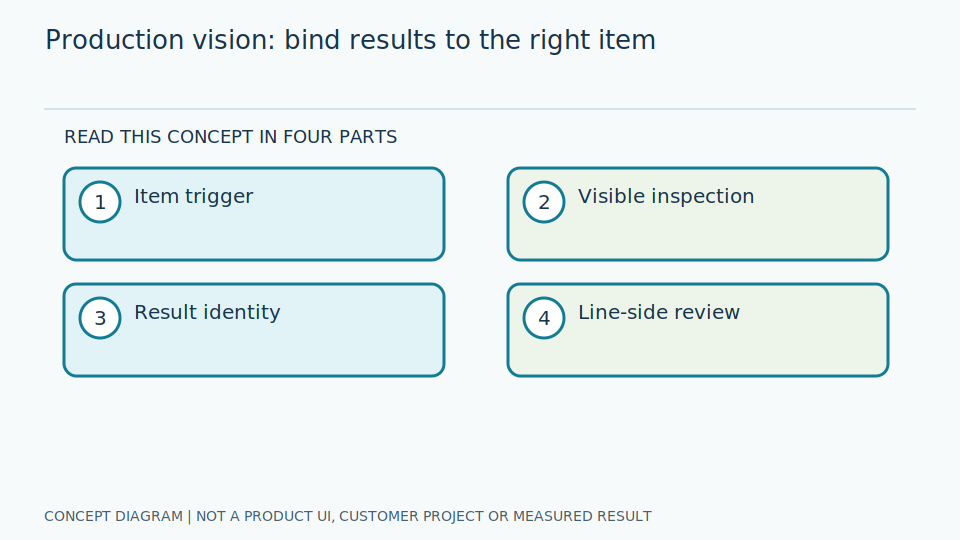
Design example: a camera inspects a triggered workpiece and sends its result with a sequence ID to the PLC before the reject point. The PLC confirms which part was actually rejected. This distinguishes a transmitted decision from the physical outcome and preserves the connection between the original image and the part affected by the command.
Suppose one result arrives late, after the next part reaches the sorting point. Without identifiers, that next part could be rejected despite correct interpretation of the first image. The destination should check identity and timing limits, with an agreed procedure for unavailable results. Do not guess or automatically use the latest result: the failure concerns association even when the classifier answers the image correctly.
Engineers first inspect simulated signals and data on paths that do not actuate machinery, then commission under an approved readiness plan. Use reference parts and safe methods to check acknowledgement. Do not independently introduce conveyor stops or missing triggers into live operations. Test sequence interpretation and confirmation of actual rejection, rather than treating a sent command as evidence that the actuator performed the intended action.
Study and Trial Workflow
- 1 Build a timing budget from conveyor speed and distance to the sorting point.
- 2 Agree handshake, timeout, and no-result states with the system integrator.
- 3 Commission with reference parts and test conveyor stops or missing triggers under an approved safe plan.
Evaluation and Metric Definitions
Measure missed deadlines, incorrect result-to-part associations, and rejection feedback alongside AI misses and false rejects. Test multiple speeds rather than only still-image inference. Evaluation needs evidence from the complete path because a correct prediction delivered too late, or delivered for the wrong part, does not constitute a successful production-line inspection and sorting operation.
A deadline miss means a result is unavailable within the defined interval; a false reject removes a part that meets the quality criteria. Separate image errors from transmission and actuation errors. Include starting part counts and confirmed destination counts. Neither still-image scores nor numbers of reject commands substitute for confirmed correct rejections. State the speed range and operating conditions checked under the approved plan.
Engineers inspect stage timings with sequence IDs in approved tests, including duplicate data, missing signals, and results arriving after timeout. Check recovery without applying old queues to new parts. If using OPC UA, verify data meaning and acknowledgements according to the design; adopting a communication specification does not certify sorting safety. Retain evidence that allows the actual part associations to be reviewed afterward.
Limitations and Failure Cases
A delayed queue can cause rejection of the next part even when the image result is correct. Real integration requires accountable engineers and a site risk assessment. Conveyor position, speed, and equipment response introduce uncertainties outside the image model, so improving inference speed alone cannot resolve every failure in the physical inspection and sorting chain.
Faster computation may reduce one delay but cannot correct a signal associated with the wrong part or an unresponsive actuator. Provide feedback and process-appropriate handling of late results. Do not disable protections or conduct risky sorting experiments to demonstrate image reading. The relevant evidence includes equipment response and identity, not simply whether the model produces a plausible classification on a captured image.
Additional checkpoints and confirmations can reduce some association failures while increasing integration and maintenance work. Assign approval responsibility and boundaries for stopping use when information is incomplete. This is integration guidance, not confirmation of current product support for PLCs, actuators, or protocols. Communication specifications and OT documents inform design; they do not certify a safety circuit or establish measured production outcomes.
Practical Checklist
- Is the sequence ID preserved throughout the path?
- What does the system do after a timeout?
- Are rejection confirmation and commissioning criteria documented?