
Content Level: Overview / Implementation considerations
Principles and Suitability
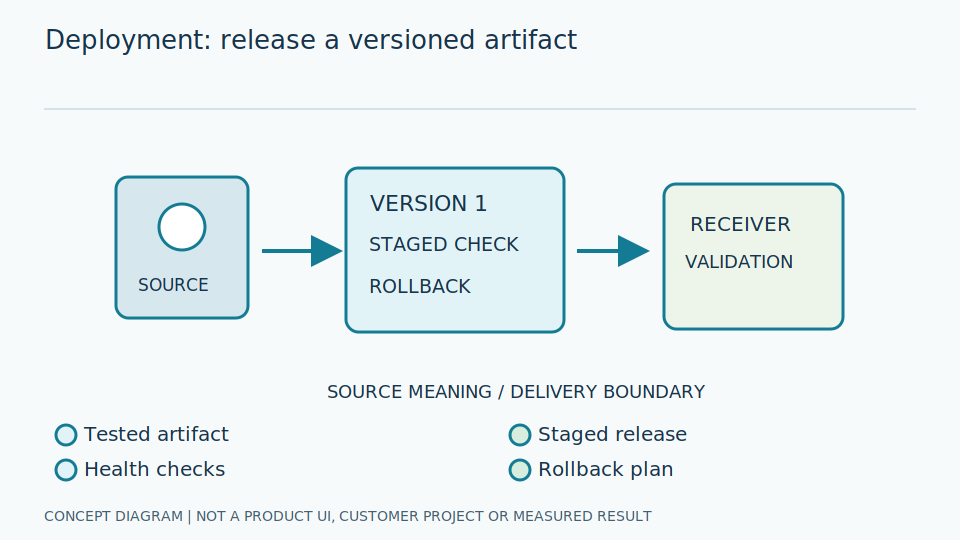
Deployment must deliver a compatible model, preprocessing, postprocessing, and configuration. ONNX is an exchange format, but opset, dynamic-shape, and operator support depend on the runtime. A TensorRT engine may be tied to its build environment. Successful file transfer or loading therefore does not establish equivalence of outputs or compatibility with the intended operating system.
Deployment is more than moving weights: images need matching preparation and outputs need matching interpretation. A package delivers related components together; a schema defines the data expected by a destination. Changing output meaning or units without informing that destination may leave messages accepted but values displayed incorrectly. Verification must therefore cover semantics, not merely successful model loading and message delivery.
An opset identifies an ONNX operator-set version; dynamic shapes allow input dimensions to vary, with runtime-dependent support. Engineers check operations, image sizes, and engine-build conditions against target hardware. Record model, configuration, calibration, and schema in one manifest. Rollback must restore related components, not just old weights if preparation or scale mappings have changed since those weights were originally used.
Scroll the diagram horizontally to inspect all details.
Illustrative Industrial Example
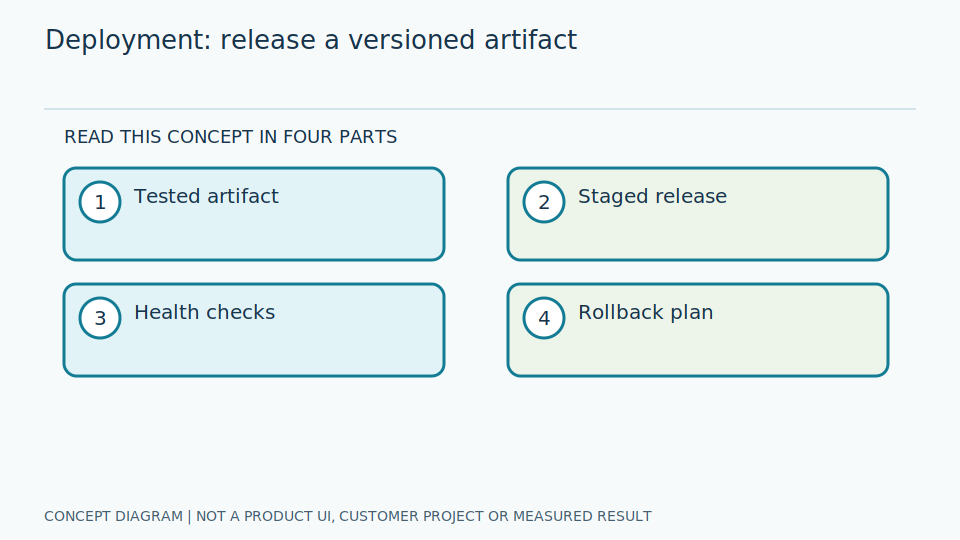
Design example: a gauge-reader package includes a model hash, scale mapping, and schema version to prevent new weights being interpreted with an old mapping. The package preserves the relationship among components, because a valid numeric output can still mean the wrong thing when its coordinate convention or physical scale belongs to a different version.
Suppose a new version returns needle points in resized-image coordinates while angle conversion still assumes original coordinates. Values can be wrong without a programming error. Reference images should verify the complete path and version pairing. Changes to units or unreadable status also require destination checks. Do not release merely because the processor starts and emits numbers; verify what those numbers represent.
Engineers may use shadow operation, running the new reader alongside without using it for decisions, or an approved risk-limited canary scope. Compare values and statuses with the original. Define stopping criteria first and test rollback of the whole package and affected data. Use conditions without hazardous control actions, checking that recovery does not mix old results with new times and versions.
Study and Trial Workflow
- 1 Verify output agreement between the original model and exported artifact.
- 2 Create a manifest covering dependencies, hardware, and configuration.
- 3 Release in shadow or canary mode according to risk, with stop and rollback criteria.
Evaluation and Metric Definitions
Test golden images, including readable and unreadable cases, on the artifact actually intended for installation. Include restart, migration, and destination schema handling, rather than evaluating only the model before export. A pre-export result does not establish that every exported operation and surrounding processing step behaves identically in the deployed environment.
Golden images have verifiable origins and expected results, including invalid conditions rather than only attractive examples. Check raw and final outputs with units, statuses, and coordinates. Define permitted numerical differences according to the task before seeing outcomes, not after problems appear. State that the installed artifact is being compared, rather than a source file following a different processing path.
Engineers verify file-content checksums before installation, then test restart, data-format migration, and actual destinations in controlled conditions. Inspect retained queues and version identifiers on every result, including export-time resource and timing changes. A partial system change requires confirmation of all related components. ONNX or TensorRT are technical options, not proof of universal runtime support or verified product speed improvements.
Limitations and Failure Cases
Successful export does not prove equivalent outputs. Rolling back only weights may be insufficient after schema or calibration changes. Version recovery must preserve data meaning across the whole package and its consumers, rather than simply demonstrate that an old model file loads or that a service can restart without reporting an immediate software error.
Export tools may alter operations or numerical representations, and some postprocessing may lie outside the exported file. Check the full path instead of assuming one file covers everything. Old-version restoration may encounter records already written under a newer schema. Plan handling of data and retained queues, not just successful service startup without confirming the meaning of information still being consumed.
Packaging components supports version pairing but adds build and storage work. Assign release approval and contextual access rights. Limited rollout reduces some impacts but cannot replace pre-use evaluation, particularly for control or safety tasks. This guide describes deployment considerations, not a claim that a platform already provides ready-to-use automatic shadow, canary, or rollback mechanisms.
Practical Checklist
- Is the deployment artifact checksum checked to verify file contents?
- Are model, configuration, and calibration versions paired?
- Has whole-package rollback been tested before delivery?