

Principles and Suitable Contexts
A variable-area flow meter uses a float position established by the forces associated with flow. Its scale depends on the specified fluid and operating conditions. It is suitable for image reading when the tube and float are visible. Read the top, centre or marked line according to the particular model manual.
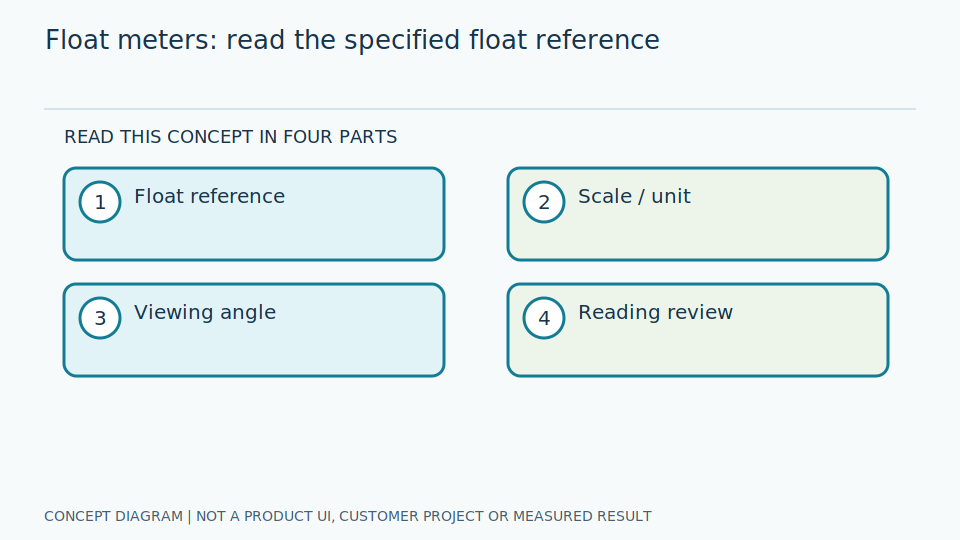
Fluid passing around the float produces an upward force until it balances weight and buoyancy. A tube widening with height provides increasing flow area as the float rises. Position therefore represents flow rate under the scale's stated conditions, not cumulative volume. Different float shapes can require different reference points; selecting a visually convenient edge does not make that edge the correct reading location.
Fluid density and viscosity affect the forces acting on the float. Do not reuse a scale for another fluid with a guessed correction formula. Transmit position, units and known operating conditions alongside the interpreted value. If essential conversion information is missing, preserve that limitation rather than presenting a calculated number as a verified flow rate simply because its image coordinates are precise.
Scroll the diagram horizontally to inspect all details.
Data and Preparation
Record float type, unit, fluid and reference pressure and temperature. Reduce parallax and reflections on the tube. Capture several positions, including oscillating behaviour, with a reference instrument appropriate for the fluid. Confirm the prescribed reading point before creating image labels or mapping position to a scale value.
Ask a reviewer to identify the manual's reading point directly on an image and confirm the selected scale. Show the tube, marks and float together to distinguish camera movement from float movement. Use normal operation or authorised records; do not request process adjustments just to fill a test range without the responsible person's approved procedure. Missing examples should remain a documented coverage limitation.
Check refraction through the tube surface and backlighting that may hide the float edge. Select lighting that reveals boundaries without obstructing instrument inspection. When the float oscillates, record multiple frames and their interval. Specify whether output represents one instant or an interval summary, since these answer different questions and require a reference measurement with the same time basis for a meaningful comparison.
Failure Cases and Limitations
Bubbles, deposits or a stuck float can make position unrepresentative of actual flow. A change in fluid density can invalidate the original scale. One still image cannot distinguish steady flow from a stuck float, so interpretation also needs equipment-condition checks and the surrounding process context.
A tube scratch or bubble edge may be selected as the float. If several positions are plausible, send the image for review rather than always choosing whichever is nearest the previous reading. Mark positions outside the graduations as beyond the readable range. Do not automatically extrapolate: there is no evidence that the same position-to-flow relationship continues beyond the documented scale endpoints.
Averaging can reduce apparent oscillation while concealing brief changes. State the result's time basis and do not treat a smoother value as evidence of normal instrument operation. When fluid conditions or installation change, responsible personnel must inspect instrument suitability separately. Do not tap the tube, dismantle equipment or manipulate the process in an unauthorised attempt to prove that a float is stuck.
Evaluation Methods
Measure float-position error separately from flow-rate error. Include low-flow onset and oscillation, and compare with a reference under the same conditions. Report results by scale region so that averaging does not conceal endpoint errors. Keep instrument suitability separate from the accuracy of locating the float in the image.
Independent reviewers should use the same reference point and record uncertainty in the float boundary before seeing system output. Determine whether differences arise from choosing the wrong edge or converting position incorrectly. For interval averages, align the reference instrument and human observations with that interval. Comparing a single frame with a long average cannot establish that the entire difference is an image-reading error.
Separate results by tube condition, fluid and the scale regions actually supported by evidence. Set distinct acceptance criteria for position and flow: precise position reading can still use an unsuitable scale. Count uninspectable and out-of-range observations. State applicable conditions and reasons for rechecking the instrument before using its records in calculations or decisions, instead of making a general performance claim.
When reviewers choose different float edges, revisit the manual and image reference point rather than immediately averaging their answers. Averaging a top-edge reading with a centre reading can create a location with no defined meaning on that scale. Retain this case in the review log and resolve the reading rule before summarising agreement or calculating a final accuracy score.
Review Checklist
- Confirm the reading point in the manual.
- Record fluid and scale reference conditions.
- Check deposits and float movement.
- Do not convert an out-of-range position into a trusted flow value.
References and Further Reading
References explain principles, not product certification. Requirements from another jurisdiction do not automatically replace local requirements or the actual equipment manual.