
Content Level: Research / Integration concept
Principles and Suitability
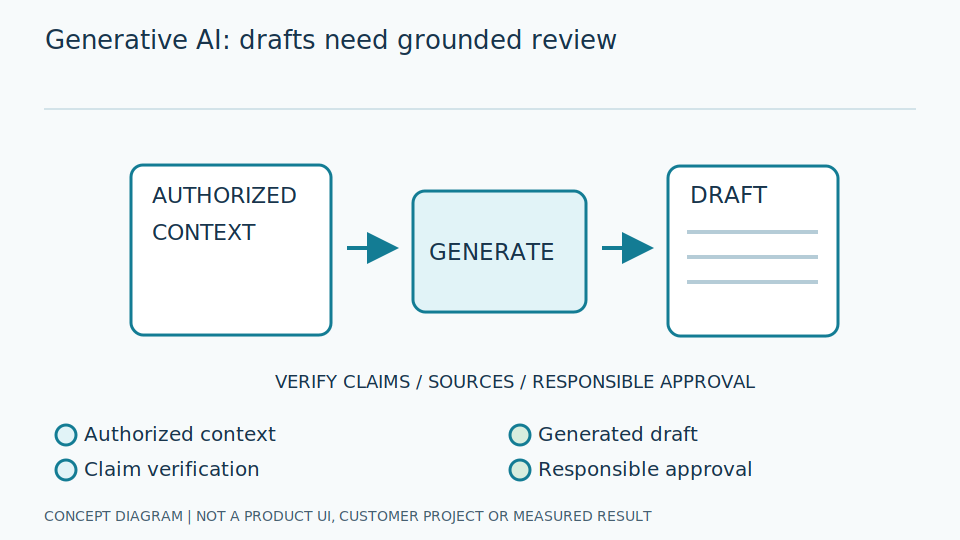
Generative AI creates text, images, or code from learned patterns; it does not independently verify facts. Manual search and report drafting must remain separate from numerical measurement, quality approval, and machinery control.
Generated content can sound coherent without being true. Hallucination means producing details without evidence. Label text as a draft and link conclusions to sources. Searching manuals may help staff find information, but generated text must not replace verified engineering instructions or recommendations to change machinery without responsible confirmation of context and safety.
Engineers restrict data, tool permissions, and output formats to the assigned role. RAG retrieves supporting information before generating answers, offering sources without guaranteeing correct interpretation. Prompt injection is text in data attempting to induce actions beyond the task. Treat documents and images as data, not instructions to change system permissions. Human approval must precede changes to real work processes; a model cannot approve its own output based on confidence.
Scroll the diagram horizontally to inspect all details.
Illustrative Industrial Example
Conceptual example: an assistant drafts a summary of no-read events from filtered logs, citing source events and images. Experts correct and approve it before use. This does not imply availability in every service package.
Suppose a log records only a blurred image. The assistant must not invent instrument failure or staff misconduct. Separate recorded observations from questions requiring investigation. Reference images and timestamps help reviewers confirm that evidence belongs to the same event. Insufficient information needs an unknown answer rather than details copied from a similar old report. Drafts must not become facts or control instructions before approval by someone who understands the context.
Engineers prepare reference questions with known answers and unanswerable cases, including documents containing misleading instructions tested with non-confidential data. Require citations to real sources and record model and prompt versions. Reviewers compare each statement against evidence. Assess content rights and provider terms before use; do not send secrets, customer images, or factory data to external services for experiments without authorization.
Study and Trial Workflow
- 1 Limit data and tool permissions and check provider terms.
- 2 Prepare reference questions including unanswerable cases and hidden instructions in documents.
- 3 Require human approval before outputs change actual procedures or systems.
Evaluation and Metric Definitions
Measure factual accuracy, citation relevance, appropriate refusal, and data leakage. Test new model or prompt versions before replacement.
Check each factual statement against confirmed sources rather than rewarding plausible language or complete formatting. A citation must genuinely support the conclusion, not merely supply a link. Separate appropriate refusal due to absent evidence from failure to answer a supported question, revealing the balance between assistance and avoiding fabrication. Check that document text cannot cause disclosure or actions outside defined permissions.
Engineers test new versions with reserved existing questions and new scoped cases, including fact reviewers and approval history. Check service latency and unavailability without substituting cached answers for new information. NIST's Generative AI Profile helps structure risks and rules, not certify models or complete compliance. Test results must not be extended into claims of current product services where support remains unconfirmed.
Limitations and Failure Cases
Hallucination, prompt injection, and uncertain content rights remain possible. RAG and citations do not guarantee correct or safe conclusions.
Incorrect or outdated sources can produce errors even when retrieval succeeds. More sources do not eliminate contradictions. Show uncertainty and request human review rather than selecting machinery advice from similar text without context. Calling a workflow step reviewer is not meaningful oversight if the person lacks evidence, authority to correct results, or the ability to stop actual use.
Drafting assistance may reduce initial effort conceptually but adds fact-checking, rights, and confidentiality work. Measure total benefits before claiming time or cost savings. This article describes research and integration concepts, not current package availability of assistants or generation tools. It offers no advice to experiment with hazardous control. Real-world output use must remain separate from measurement and approval processes with responsible owners.
Scroll the diagram horizontally to inspect all details.
Practical Checklist
- Are secrets and customer data withheld without approval?
- Is generated text distinguished from established facts?
- Are reviewers and approval audit trails available?