
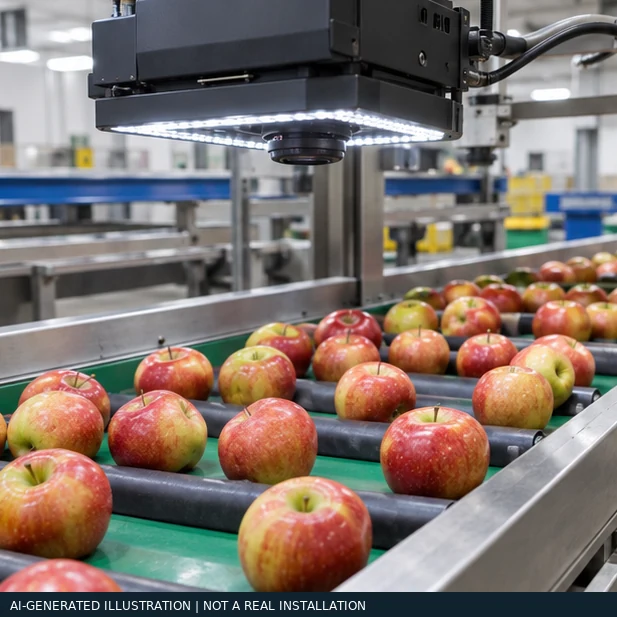
Principles, Scenarios and Suitability
Image inspection assesses external produce characteristics such as colour, shape, size and surface marks. Grade criteria need a named variety and destination market. External colour does not necessarily establish sweetness, internal ripeness or product safety.
A grade groups characteristics required by a market; it is not a score for every quality aspect. Different colours may indicate different varieties or harvest periods. Establish whether the task grades size, inspects marks or estimates colour, and do not substitute an image grade for internal properties. Sweetness requires a reference measurement answering that question, not inference from an image's fresh appearance.
Colour calibration gives comparisons a common basis; size scaling requires checking distance and shape. Rotating produce reveals more sides but adds matching work and may bruise it during handling. Choose gentle methods and criteria reviewers agree on. Split data by origin and season rather than distributing views of the same fruit across sets and making tests look better than operation on new sources.
Scroll the diagram horizontally to inspect all details.
Illustrative Design Scenario
Illustrative design scenario: grade size and surface marks using several views, referring borderline results to reviewers. Batch and variety records prevent the colour criteria for one variety from being used to judge another.
Suppose produce from a new source has darker skin but reviewers assign the same grade. Check variety and lighting before changing criteria. Image colour does not justify claiming deterioration or blaming a grower for supplying the wrong product. Options include variety-specific criteria or additional reviewer-confirmed reference data, retaining reasons and applicable scope.
Borderline size results can be remeasured using suitable instruments. Manual review takes time but helps prevent uncertainty assigning the wrong grade. Reviewers should check several sides and identify unseen surface areas. Use sample produce separated from saleable work under the trial plan, not bruise it or employ risky methods to create defect examples.
Inputs and Prerequisites
Use applicable grading standards, varieties, seasons, samples from multiple origins and reference measurement methods. Include views hidden from a single camera and examples of uneven colour.
Keep batch codes, variety, lighting, grading method and the criteria revision used by responsible personnel. Separate different market standards; a cited requirement does not automatically apply to every product.
Results should state the grade for inspected characteristics, size with units and completely visible angles. A single-side image needs a limitation, not a conclusion about the whole skin or unmeasured internal properties. Define size as diameter, length or image area: non-round produce gives different answers. Market comparison requires the same quantity. Do not convert area to weight without a model and weighing evidence.
Trial and Integration Workflow
- 1Agree on grade definitions and borderline decisions with reviewers.
- 2Capture multiple views with controlled lighting and a size reference.
- 3Split by origin and season to test beyond the original batches.
Evaluation and Acceptance Criteria
Measure reviewer agreement and size error by grade, variety and season. Estimates of internal properties need separate reference results from suitable measurement methods. Do not infer those properties from colour without supporting evidence.
Check agreement between graders before treating labels as reference answers. Resolve disagreements by reviewing criteria, not choosing the label that makes the model correct. Hold out different origins to expose limitations outside original data coverage.
Reviewers should sample every grade and remeasure borderline items. Report group counts and hold rates. Dominant grades must not hide rare groups in aggregate results. Recheck after season and capture-condition changes.
Scroll the diagram horizontally to inspect all details.
Failure Cases and Limitations
Wet surfaces, dust and natural light alter apparent colour. Internal bruising may not yet be visible. One season of training does not cover every source, and an image grade is not a pesticide-residue or hygiene certificate.
Colour-property relationships may change with variety and storage. Future internal-property estimates require reference data and specific tests, not attractive photographs or bright colours in place of analysis.
Retain and disclose origin data only as necessary. Scores should not automatically accuse growers or establish liability. Studying standards-based grading is a design approach, not product certification for every market.
Practical Checklist
- Do criteria match the actual variety and destination market?
- Is enough surface visible to support the proposed conclusion?
- Have held-out seasons or origins been included in testing?