
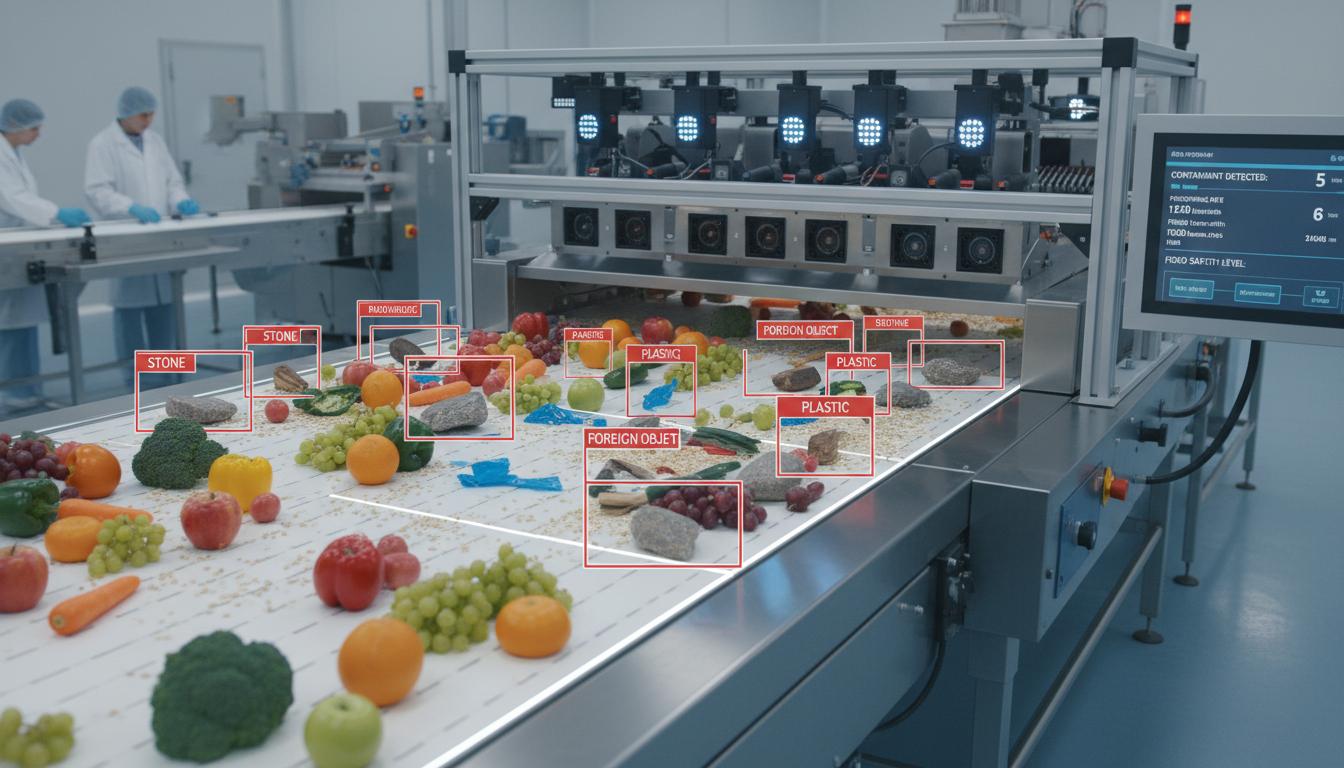
Principles, Scenarios and Suitability
Vision can screen foreign material visibly different from food under defined conditions. Separate this from detecting microbes, chemicals, allergens or hidden foreign objects. Design the screening within the existing food-safety system rather than treating visible inspection as a complete safety assessment.
Vision uses images to help observe objects, much like picking material fragments from produce on a table. A camera sees only unobscured surfaces. Colour differences help screen some objects, while food-coloured or internal material may remain invisible. Hazard analysis must start with the food and process, not with whatever the model can find followed by a claim of complete safety coverage.
HACCP is an approach to analysing hazards and controlling critical points. Images are one tool whose role and limits require assessment. A thin food layer improves visibility but needs more space and may restrict throughput. Greater sensitivity also holds more good food. Food-safety personnel should choose methods and inspection evidence, including tracking test specimens and removal; images do not certify readiness for consumption.
Scroll the diagram horizontally to inspect all details.
Illustrative Design Scenario
Illustrative design scenario: inspect contrasting fragments on produce spread in a thin layer, then have reviewers confirm and remove them. Mark overlapping or hidden food as uncovered instead of declaring it acceptable because no object was detected.
Suppose produce overlaps so only its top layer is visible. Operators should consider improving distribution before adding cameras: several cameras still cannot see between layers. Reducing thickness also requires considering throughput and handling damage. Quality personnel should determine whether visible coverage is sufficient for the targeted foreign material.
Trials require approved controlled specimens separated from saleable products and tracked until every specimen is recovered. Reviewers must confirm both detection and the removal route: seeing an object but removing the wrong item does not fulfil the task. Future sorter integration requires timing and unknown-result tests in a test system. Do not introduce hazardous objects into a real food line to generate data.
Inputs and Prerequisites
Define contaminant types, sizes, shapes, colours, food products, layer thickness and quality-team-approved test methods. Test specimens must not create contamination risks in products intended for sale.
Data should identify food type, batch, obscured image areas and controlled-specimen codes. Retain labelling methods from responsible personnel. An unusual colour alone does not justify labelling an unconfirmed object as genuine contamination.
Results should identify proposed objects, positions, image evidence and uncovered areas, with independently checked removal status. Not found means not found under the visible conditions, not absence of every kind of hazard.
Trial and Integration Workflow
- 1Use hazard analysis to distinguish what images can and cannot detect.
- 2Design food presentation and lighting to expose the inspection area.
- 3Test controlled specimens and removal under conditions approved by food-safety personnel.
Evaluation and Acceptance Criteria
Measure detection and actual removal separately by object type, size and position, including false rejects of good food. Account for all test specimens and assess occluded periods. Aggregate accuracy does not certify food safety.
Test challenging sizes and colours under the approved plan, alongside good food from multiple batches. Do not base conclusions entirely on strongly contrasting objects. Separate image-detection failures from matching and removal failures to correct the right stage.
Quality personnel should reconcile controlled specimens before and after trials. Record unreadable results and overlapping areas as limitations. Passing data-system criteria does not establish that food-control measures have been validated for the actual process.
Scroll the diagram horizontally to inspect all details.
Failure Cases and Limitations
Material matching food colour or embedded inside it is difficult to detect. RGB images do not establish microbial status or fitness for consumption. Screening does not replace HACCP, laboratory tests or other instruments required by hazard analysis.
RGB represents red, green and blue image channels, not chemical or microbial analysis. Changes in food, moisture and lighting may alter results. Review with food specialists before reusing old criteria; do not generalise from one produce type.
Hygiene standards provide a study framework, not certification of products, detectors or factories. Adding contaminant types is a new design task requiring demonstration, not a claim that invisible hazards can already be detected.
Practical Checklist
- Are hazards outside the image scope explicitly documented?
- Are test specimens kept out of products for sale?
- Has the food-safety team approved inspection and removal methods?