
Principles, Scenarios and Suitability
Occupancy estimates can support energy planning without identifying individuals. Prefer aggregate counts by area and period over personal tracking. Counts carry uncertainty and do not prove that a room is definitely empty.
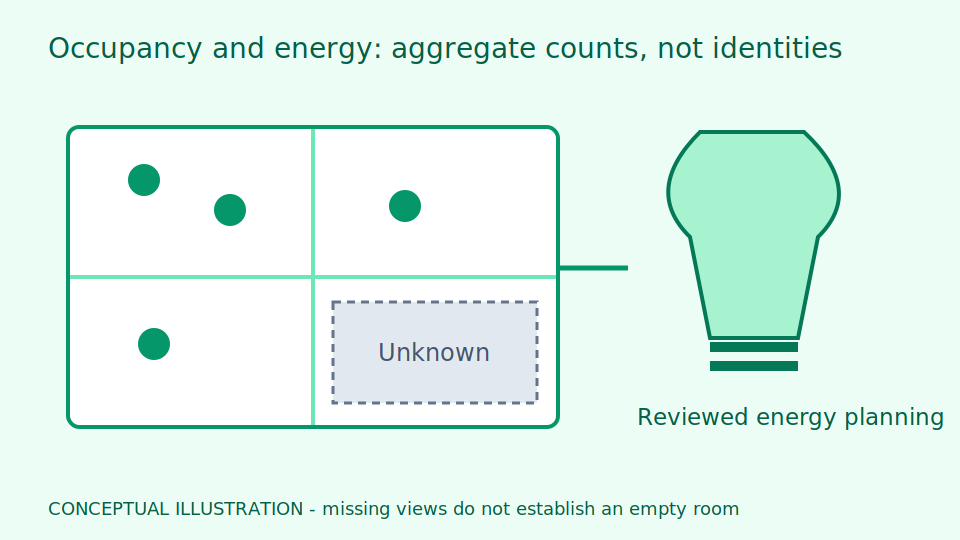
Occupancy means use or the number of people in an area. Aggregates answer when rooms are used without needing identities. Visible counts differ from total counts: stationary or out-of-view people may be missed. No visible person does not certify emptiness. Information is better suited to helping operators review schedules than immediately switching off lighting or essential systems from one interval.
A baseline estimates energy under comparable weather and workloads, giving interventions context. Coarse aggregation reduces identification risk but loses short-period detail. Choose enough detail for the question. Operators should define comfort and ventilation boundaries under actual requirements. Headcounts do not measure air quality or authorise reducing systems below necessary levels.
Scroll the diagram horizontally to inspect all details.
Illustrative Design Scenario
Illustrative design scenario: zone totals help review lighting and air-conditioning schedules. Operators set comfort limits and minimum ventilation. Essential systems are not immediately switched off simply because an image contains no detected person.
Suppose a room is used on some evenings while the building schedule stays the same daily. Operators could adjust schedules from appointments and checked aggregate counts, or ask users to report additional use. The first supports planning but needs missing-data handling; the second requires more communication. Both must preserve comfort and minimum ventilation, not switch off from one empty image.
Compare interventions across days with similar weather and workloads, including complaints and suitably measured air quality. Lower electricity totals are not success if people are uncomfortable. Test false-empty results using non-identifying counts and simulations, not leave users in unsuitable conditions or actually shut down essential systems to see whether cameras detect them.
Inputs and Prerequisites
Use area layouts, operating hours, ventilation plans, energy baselines and non-identifying reference counts. Define local processing and avoid retaining images beyond what the purpose requires.
Keep zone codes, times, camera-occlusion intervals and aggregate references, with weather and usage schedules. Do not add names or faces when totals answer the question. Responsible personnel should confirm retention policies.
Results should show estimated count, interval, quality, unknown status and counting boundaries. Camera loss must not appear as zero. Energy summaries need occupancy-data completeness stated before comparison.
Trial and Integration Workflow
- 1Assess whether non-identifying aggregate counts satisfy the stated purpose.
- 2Test counting with explicit occlusion and missing-data states.
- 3Trial schedule changes within comfort limits against a load-adjusted baseline.
Evaluation and Acceptance Criteria
Measure count errors and false-empty results by zone alongside comfort, air quality and context-adjusted energy use. Account for weather and schedules when assessing savings instead of attributing raw before-and-after differences to the intervention.
False empty means people are present but the area appears empty. Evaluate separately from small count errors because system-adjustment consequences differ. Use authorised timestamped reference counts, not only periods when everyone is clearly walking.
Operators and users should review results against building limitations. Test missing-data days and restoration of previous schedules in a test system. Report intervention changes with uncertainty, not convert educational examples into measured savings.
Scroll the diagram horizontally to inspect all details.
Failure Cases and Limitations
Stationary people, unseen areas and crowds can cause errors. Do not infer health, emotion or job performance. This is not a substitute for evacuation counting with its own evidence requirements, and people must oversee building-system adjustments.
Aggregates may still identify people in small spaces or finely divided periods. Assess risk and reduce detail as necessary. Local processing does not remove duties to protect data and affected people's rights.
Automatic building adjustment is a future task needing actual system and condition checks, not existing control capability or safety certification. Preserve manual operation and emergency measures independent of images.
Practical Checklist
- Can aggregate data replace individual identification for this purpose?
- Can false-empty results avoid shutting down essential systems?
- Is the energy baseline adjusted for occupancy patterns and weather?